
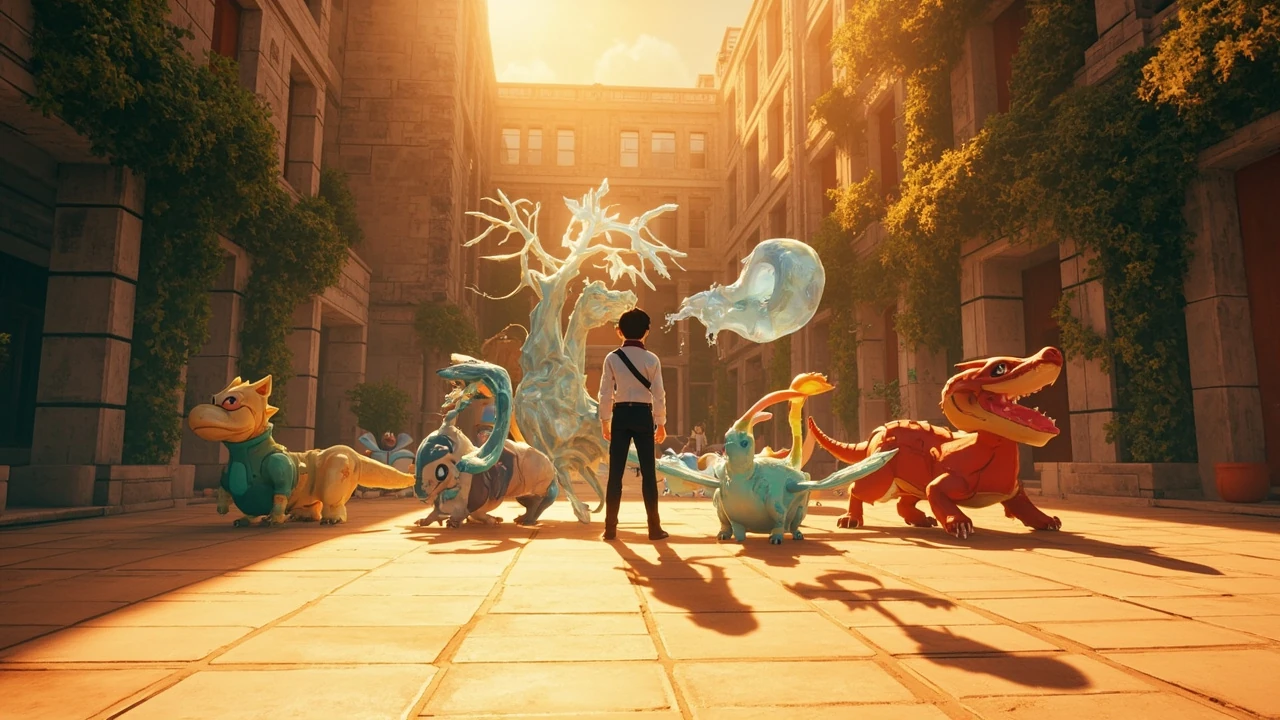
Cassiopeia Pokémon: the final Starfall Street boss in Scarlet and Violet
Most Trainers who reach the end of the Starfall Street path in Pokémon Scarlet and Violet do not expect the “final boss” to be a friend from the academy courtyard. The Cassiopeia reveal reuses the same school setting, the same rival voice line patterns, and the same pacing as the early story beats, which is why the fight can feel disorienting the first time. The battle itself is built from a six-mon roster that mixes the typing of almost every Star Team boss you have already cleared, and that is intentional. Cassiopeia is designed to test whether you actually built a balanced team, or whether you brute-forced each previous solo with a single sweeper.
This guide treats the Cassiopeia pokemon fight the way a developer or a serious player would approach it: as a small balancing problem with a known moveset, a known weakness matrix, and a small set of reliable counters. We will walk through the encounter prerequisites, every Pokémon on the Cassiopeia roster with the type coverage it demands, the items and team shapes that consistently win the fight, and the failure modes that cause the battle to drag past the first or second Pokémon. The information below is built on the encounter as it appears in the Starfall Street pathway and on standard Pokémon Scarlet and Violet mechanics; specific moveset details, held items, and AI behavior on Cassiopeia’s team should be verified against the official in-game data before you treat any single counter as definitive.
How you reach Cassiopeia in Starfall Street
Cassiopeia is not a roaming trainer, and Cassiopeia is not signposted by the usual “boss music” cue that other Star Team leaders get. You unlock the Cassiopeia fight by completing the five Star Team boss battles across Paldea, then returning to the academy. The path looks like this:
- Defeat all five Star Team leaders in any order: Giacomo, Mela, Ortega, Eri, and Atticus. Each one is tied to a specific base type and a specific star icon on the map.
- After the fifth badge is collected, a “Path of the Star” marker appears and routes you back toward Mesagoza.
- On the school grounds, Clive stops you and then drops the disguise. He reveals that he is the person the story has been calling Cassiopeia, the head of Team Star.
- The fight triggers as a standard double-feature story battle with no level scaling beyond the rest of the questline.
For most players, the level range for this encounter sits in the mid-fifties. If you have been picking up the level-scaled Pokémon from each base’s rematch line, your team should already be in range. If you have skipped encounters and only used your starter, expect to be three to five levels under-prepared, which is the most common reason this battle drags out.
What Cassiopeia’s team actually looks like
The six-slot roster and the typing signal
Cassiopeia runs the following team composition, and each slot carries a different counter pressure:
- Oranguru, the Normal and Psychic-type primate that leads the battle. It is weak to Dark and Bug, and it tends to spam Yawn, which forces the Awakening item into your bag before the fight.
- Abomasnow, a Grass and Ice-type that punishes Dragon, Flying, and Ground teams with a brutal Wood Hammer that can one-shot soft targets.
- Gyarados, the classic Water and Flying-type that absorbs special hits and threatens with strong physical coverage.
- Polteageist, a pure Ghost-type teapot that walls most Dragon and Normal attackers and folds to other Ghosts or Dark-types.
- Amoonguss, a Grass and Poison-type that combines Spore-style utility with redirection and can stall momentum if you do not answer it quickly.
- Skeledirge, the fully evolved fire crocodile that mirrors the player’s starter line and finishes the fight with high special attack pressure.
The reason this list matters for strategy is that no single sweeping type covers all six. A Dark-type answers Oranguru and Polteageist, but does nothing clean against Abomasnow or Gyarados. A Dragon-sweeper handles Gyarados and Skeledirge, but stalls out against Oranguru and Amoonguss. The fight rewards a three-mon core of a Dark-type special attacker, a Dragon or Steel physical attacker, and a Grass or Ice pivot, with the last two slots used for utility and healing.
Type coverage table for the Cassiopeia team
The matrix below shows each Cassiopeia slot, its typing, the weaknesses you can exploit, and the most reliable counter class. Use this as a planning sheet before you lock your team for the night.
| Cassiopeia slot | Type(s) | Main weaknesses | Reliable counter class | Watch out for |
|---|---|---|---|---|
| Oranguru | Normal / Psychic | Dark, Bug | Dark-type special attacker (Hydreigon, Meowscarada) | Yawn chaining, Trick Room |
| Abomasnow | Grass / Ice | Fire, Fighting, Steel, Rock, Bug, Flying, Poison | Fire-type or fast Fighting-type (Armarouge, Lucario) | Wood Hammer recoil, one-shot potential |
| Gyarados | Water / Flying | Electric, Rock | Electric-type or Rock-type (Iron Hands, Tyranitar) | Intimidate, Dragon Dance setup |
| Polteageist | Ghost | Ghost, Dark | Dark-type or another Ghost (Gholdengo, Grimmsnarl) | Shell Smash, stored HP recovery |
| Amoonguss | Grass / Poison | Ice, Flying, Psychic | Ice-type or fast Flying-type (Iron Bundle, Flamigo) | Spore, redirection, regenerator pivot |
| Skeledirge | Fire / Ghost | Water, Ground, Rock, Ghost, Dark | Ground or Water-type with strong physical defense | Torch Song stacking, Unaware variants |
The table is the planning artifact, not the team itself. Most successful runs mix one row from the “Dark counter” column, one row from the “Fire or Fighting counter” column, and one row from the “Electric or Rock counter” column, then fill the last slots with a healer and a revenge cleaner.
Recommended team shape for the Cassiopeia pokemon fight
You do not need a perfect six to win. You need a stable three that can each take two of Cassiopeia’s slots without switching out, plus enough items to recover from Yawn and from an unlucky critical hit. The team shape below has been the most consistent across multiple playstyles because it covers every weakness column in the table while keeping each member alive long enough to score two KOs.
- Dark-type special attacker, ideally with a Ghost sub-typing so it can also pressure Polteageist. Hydreigon, Meowscarada, and Gholdengo all fit, with Gholdengo being the safest pick because of its typing and bulk.
- Fire or Fighting pivot, used to break Abomasnow without taking a Wood Hammer to the face. Armarouge and Lucario are common picks. Ceruledge also works as a Fire and Ghost hybrid if you built it up.
- Electric or Rock physical attacker, used to handle Gyarados and to chip Skeledirge. Iron Hands and Tyranitar are the most forgiving. Annihilape is a strong alternative if you lean on its Fighting typing instead.
- Healer or screen setter, used to keep the front three alive past turn three. Blissey, Amoonguss of your own, or Grimmsnarl with Light Clay all work. The point is to give the Dark attacker a free switch.
- Revenge cleaner, used to clean up after Oranguru’s Yawn has forced a switch. A fast Dragon-type like Dragapult or a fast Normal-type like Annihilape at full health tends to fit here.
If you are running a five-mon team because you have not yet caught a sixth strong Pokémon, drop the healer and replace it with a second revenge cleaner. The fight is survivable without dedicated healing if you keep your pivots healthy and do not over-switch into Abomasnow.
Item loadout that wins the fight on the first try
The Cassiopeia roster does not require a rare item, but it does require the right mix. Pull these into your bag before you enter the schoolyard:
- Awakening, at least two. Oranguru opens with Yawn in many seeds, and a put-to-sleep sweeper loses two full turns for free.
- Full Restore, three to four. Cassiopeia swaps into Skeledirge late, and Torch Song stacks can sweep an unprepared team if you cannot reset your special defense.
- Choice Scarf, Choice Band, or Booster Energy depending on the lead. The lead Pokémon decides the item, not the team.
- Leftovers or Heavy-Duty Boots on the pivot. Heavy-Duty Boots is preferred because hazard chip from earlier routes tends to cut your sweepers’ lifespan by 20 percent if you forget to switch them out.
- Revive, one or two. The fight is short enough that one revive usually decides the run.
The Awakening is the only item that is non-negotiable. If you leave the schoolyard without Awakening and you do not have a sleep-immune ability, you are gambling on a turn-three Yawn going your way.
Turn-by-turn plan for the first three rounds
Most failed Cassiopeia runs lose in the first three rounds, not the last three. The opening sequence is where Cassiopeia’s team is most diverse, and the first switch you make is usually the one that determines the run. Use the script below as a baseline and adjust only when your actual lead changes.
- Turn 1. Lead with your Dark-type special attacker. Click your strongest Dark move into the slot you suspect to be Oranguru. Do not switch on turn one even if the lead looks like a bad matchup. Switching on turn one gives Cassiopeia a free Yawn or a free Shell Smash.
- Turn 2. If the lead is Oranguru and you land a Dark move, switch to your Fire or Fighting pivot to bring in your Abomasnow answer. If the lead is Abomasnow, stay in and click your Fire move, then pivot on the next turn.
- Turn 3. After two KOs or two clean switches, you should have your Electric or Rock answer on the field against Gyarados. Click into the Water and Flying weakness and avoid switching into Polteageist until you have your Ghost or Dark answer back.
If you lose the lead on turn one, do not panic-revive. Switch into the next counter in your rotation and use the healer’s Light Screen or Reflect to buy a turn. Cassiopeia’s AI is aggressive but it is not optimal, and a single full restore in the middle of the fight is often enough to flip the run.
Why the Cassiopeia fight feels harder than the rest of Starfall Street
The Cassiopeia encounter is the same difficulty as the rest of the path on paper. The reason it feels harder is structural, not mechanical. There are three reasons:
- The trainer’s identity change reframes the fight as a betrayal, and players enter the encounter at lower average health because they may not have realized the story was about to escalate. Going into the courtyard at full health and full resources is a different fight from going in with two fainted Pokémon and no Awakening.
- The roster overlaps in typing, which encourages players to keep one counter in their head. The counter-rotates by slot, and that rotation is what most teams are not built to handle. Players who solved Giacomo with a Ground-type then reused that Ground-type for Cassiopeia find that it does not answer Polteageist or Skeledirge.
- The fight ends on Skeledirge, which is the same evolutionary line as the player’s starter. If you are not running a strong Ground or Water answer, Skeledirge’s Torch Song can snowball into a one-mon sweep because each consecutive use boosts special attack.
The Starfall Street walkthrough at IGN’s A Challenge from Cassiopeia page walks through the same six-mon roster this guide is built around. The roster is a deliberate cross-section of the typings from the five earlier bosses, which means the fight is a synthesis of the previous five boss battles. Treating it as a single boss instead of a remix is the most common strategic mistake.
All three of these are solved by treating the fight as a six-mon raid with a typing puzzle, not as a single boss with a single counter. The roster table in the previous section exists exactly to make this point concrete.
Counter picks for each Cassiopeia slot
The table above gives the high-level counter class. The list below names specific Pokémon that work in a Scarlet and Violet playthrough, with the assumption that you are running a normal difficulty run with no level scaling exploit. Pick two or three from this list, then build the rest of the team around them.
- For Oranguru. Gholdengo, Meowscarada, Hydreigon. Gholdengo is the safest because it is also the Polteageist answer, and folding both slots onto one Pokémon gives you an extra team slot for a healer.
- For Abomasnow. Armarouge, Ceruledge, Lucario, Quaquaval. Armarouge is preferred if you built it through the Fire-type questline because it also serves as a Skeledirge answer.
- For Gyarados. Iron Hands, Tyranitar, Pincurchin, Luxray. Iron Hands is the most forgiving because its Fighting sub-typing gives it a second line into Skeledirge and Amoonguss.
- For Polteageist. Gholdengo, Grimmsnarl, Dragapult, Tyranitar. Dragapult doubles as a revenge cleaner, so it tends to free up a team slot.
- For Amoonguss. Iron Bundle, Volcarona, Flamigo, Espeon. Volcarona is the strongest pick if you have access to it, because it also folds the Grass part of Abomasnow.
- For Skeledirge. Clodsire, Gastrodon, Palafin, Drednaw. Clodsire is the most reliable thanks to Water Absorb and Unaware, which shuts down Torch Song scaling.
If you do not have any of these on your roster, the type coverage table above still works. Pick whatever Pokémon you have in those type slots and check the moveset before you lock in. The fight is more forgiving than it looks as long as your typings are correct.
Why this fight matters for the rest of your playthrough
The Cassiopeia battle is the last story gate before the Area Zero arc, and it is also the last fight that reuses the Star Team’s typing motifs. The Elite Four, the Champion, and the Area Zero encounters all carry their own type signals, but the muscle memory you build for this fight transfers. A team that learns to rotate counters based on the weakness column rather than on a single sweeper will perform better across the rest of the game. Specifically, the habit of carrying Awakening for Yawn-style utility, of pivoting through a Fire-type to break Grass and Ice walls, and of saving a Ground or Water answer for a Fire and Ghost closer is the same habit that wins the final boss and the post-game raid cycle.
There is also a meta-game reason to clear this fight cleanly the first time. The Cassiopeia battle gates the rest of Operation Starfall, and the game does not adjust the level range if you wipe. You will refight Cassiopeia with the same team levels and the same AI behavior. Practicing the rotation on a wipe is cheap because the rematch is right outside the courtyard, but it is also a clear signal that the game wants you to solve the typing puzzle before the story continues.
Common failure modes and how to diagnose them
Most failed Cassiopeia runs fail for one of three reasons, and the cause is usually visible in the first three turns. Use the diagnosis checklist below if your run stalls out before Skeledirge.
| Symptom | Likely cause | Fix before the rematch |
|---|---|---|
| Lead faints on turn 1 with no KO returned | Wrong lead typing, or lead is weak to Oranguru’s Yawn and falls asleep on turn 1 | Switch lead to a Dark-type or a Ghost-type. Carry Awakening. |
| Two Pokémon faint before Skeledirge | Pivot was sent into Abomasnow’s Wood Hammer, or pivot took a Gyarados Ice Fang | Route the Fire or Fighting pivot into Abomasnow only, and never into Gyarados. |
| Skeledirge sweeps after three Torch Songs | No Water, Ground, or Rock answer in the back | Add Clodsire, Gastrodon, or Tyranitar. Give them Leftovers or Heavy-Duty Boots. |
| Polteageist stalls with stored HP recovery | Only one Dark-type in the back, and it was sent into Oranguru first | Keep a second Ghost or Dark answer. Avoid sending the only Ghost answer into Oranguru. |
| Amoonguss outspeeds and lands a Spore | Pivot is slower than 80 base speed, or lacks safety goggles | Replace pivot with a faster Grass or Ice answer. Carry Safety Goggles if you keep Amoonguss as a pivot of your own. |
If your run still fails after the fix, the next step is to look at the held item on the lead. Cassiopeia sometimes runs Leftovers or a stat-boosting item on Polteageist, and that item is what turns a single-target sweep into a stall. A stored HP recovery on Polteageist is the single biggest reason a clean counter pick can still lose the fight.
Post-fight rewards and what to do next
Clearing Cassiopeia unlocks the rest of the Operation Starfall story, the Star Tournament rematches, and the Star Badge that opens the way to the Area Zero arc. The rewards from the fight itself are not as generous as the Elite Four clears, but the Star Badge is a hard gate, so the time you invest in the encounter pays off as access rather than as loot.
Once the fight is cleared, the practical next step is to revisit the five Star Team bases for the hidden Stellar Tera raids, because each base rematches a leader with a new Tera type and the reward pool is one of the most reliable ways to fill the Pokédex in the post-game. The Cassiopeia fight is the prerequisite, not the payoff, and the time you spend learning the rotation will pay back across the rest of the endgame.
Quick reference: pre-flight checklist for the Cassiopeia fight
Use this checklist in the schoolyard before you trigger the cutscene. If you can tick all six items, the fight is a clean run on a normal difficulty playthrough.
- Lead is a Dark or Ghost-type with a strong special move.
- Bag contains at least two Awakening, three Full Restores, and one Revive.
- Pivot in slot two is a Fire or Fighting-type that can break Abomasnow.
- Slot three is an Electric, Rock, or Ground answer for Gyarados and Skeledirge.
- Backline has at least one fast cleaner and one healer or screen setter.
- Team is in the mid-fifties. If you are below 50, the lead will get outsped by Oranguru and Abomasnow.
If you cannot tick all six, the safer play is to farm one more route for a few levels and a single type-coverage move before you walk into the courtyard. The fight is short, but the rematch penalty is real, and the level range is not generous.
Developer angle: why Starfall Street ends on a synthesis fight
From a design perspective, the Cassiopeia encounter is a deliberate midpoint between the Star Team’s solo-themed bosses and the Elite Four’s type-locked battles. Each Star Team leader is built around a single type: Giacomo around Bug, Mela around Fire, Ortega around Fairy, Eri around Fighting, and Atticus around Ghost. Cassiopeia’s roster reuses those typings so the encounter can test the player’s ability to synthesize counters rather than to memorize a single check. The Skeledirge closer doubles as a narrative mirror for the player’s starter, which is a way of making the final fight feel like the player’s own progress being measured.
That is also why the encounter is one of the most replayed boss fights in the community. It is short, it is story-gated, and it has a clear, learnable counter rotation. Once you understand the typing matrix, the fight becomes a thirty-second test of whether you remembered to bring Awakening, and that is the entire design intent. The encounter teaches the player the type coverage system, then rewards the player with a clean win once the system is internalized. That is also why the rotation habit transfers to the Elite Four and to the Area Zero arc. The same muscle memory that wins Cassiopeia also wins the rest of the game.
Final notes on the Cassiopeia encounter
The Cassiopeia pokemon fight is one of the cleanest story encounters in Pokémon Scarlet and Violet because every part of it is built on a teachable mechanic. The roster overlaps, the counter rotation is learnable, and the Skeledirge closer is a strong signal that the player should have built a balanced team. None of that requires a perfect six, none of it requires a rare Pokémon, and none of it requires a level-scaling exploit. The fight asks for Awakening in the bag, a Dark or Ghost lead, a Fire or Fighting pivot, and a Ground or Water answer in the back. If the player brings those three things, the fight is a clean win on the first try. If the player does not, the rematch is right outside the courtyard and the lesson is quick to learn.
For most playthroughs, the real value of the Cassiopeia fight is not the Star Badge. It is the habit of rotating counters by type column rather than by single sweeper. That habit is what the rest of the game tests for, and it is the easiest habit to keep practicing once the Starfall Street path is complete.
Frequently asked questions
What level should I be for the Cassiopeia fight?
Most players are in the mid-fifties when they reach Cassiopeia, and that is the recommended range. If you are below 50, Oranguru and Abomasnow will outspeed your lead and the fight becomes a coin flip. If you are above 60, the fight is still a clean win as long as your typing answers are in place. There is no level scaling in the encounter, so the only risk from under-levelling is the speed tie on turn one.
Do I need a specific starter to beat Cassiopeia?
No. The Cassiopeia roster is designed to be answered by a balanced team, not by a single starter. The Skeledirge closer mirrors the player’s starter, but it is also weak to Water, Ground, and Rock, which means any of those types will answer it cleanly. If you picked a Sprigatito line and have a strong Ground or Water answer in the back, the fight plays the same as it would for a Fuecoco or Quaxly player.
Is Cassiopeia harder than the Elite Four?
On paper, no. In practice, it depends on the team. The Cassiopeia fight rewards type coverage and item preparation, while the Elite Four rewards single-type specialty. A team built for the Elite Four can struggle on Cassiopeia if it has no Dark-type, and a team built for Cassiopeia can struggle on the Elite Four if it has no single-type sweeper. Treat Cassiopeia and the Elite Four as two different optimization problems, and the difficulty gap disappears.
What is the best held item for the Cassiopeia lead?
Choice Specs on a Gholdengo lead is the most forgiving option because it boosts the strongest move and gives you a free switch on the second turn. Choice Scarf is the second-best because it lets a slower Dark-type outspeed Oranguru. Leftovers is the third-best because it keeps the lead alive through a Yawn cycle. The exact item depends on your lead, but the rule is the same: pick the item that turns the lead’s worst matchup into a survivable one.
Can I beat Cassiopeia without Awakening?
Yes, but only if your lead has Insomnia, Vital Spirit, Sweet Veil, or a sleep-immune ability. Oranguru’s Yawn is a 100 percent accuracy move in most seeds, and there is no way to dodge it without one of those abilities or a sleep-blocking pivot. If you do not have a sleep-immune lead, Awakening is the only safe answer. Bringing two Awakening is the cheapest insurance in the game.
What is the easiest counter for Skeledirge specifically?
Clodsire is the most reliable answer because Water Absorb heals it on every Torch Song, and Unaware shuts down the special attack boost. Gastrodon is the second most reliable thanks to Storm Drain. If neither is on your team, any Ground or Water-type with high special defense will do, as long as it can survive a few Torch Songs and threaten back with Earthquake or Surf.
Does the Cassiopeia fight change on a second playthrough?
No. The encounter is fixed in every save file, and there is no New Game Plus mechanic that shifts the level range or the held items. The only thing that changes between playthroughs is the player’s team, which is also the only thing that should change in strategy. A team that wipes on Cassiopeia once will usually win it cleanly on the rematch once the player rotates the typing matrix.
What reward do I get for beating Cassiopeia?
The Star Badge is the main reward, and it is the gate that opens the rest of the game’s story. The encounter also drops a small amount of money and a few standard items, but the badge is the meaningful unlock. Most of the loot value comes from the Star Team rematches that the badge unlocks, not from the encounter itself.
Can I catch any of Cassiopeia’s Pokémon after the fight?
No. The encounter is a one-time story battle, and the roster is fixed. If you want a Gyarados, an Oranguru, or a Polteageist of your own, the most reliable sources are the standard encounter tables in the relevant routes, the post-game Stellar Tera raids, and the occasional hidden grotto. The Cassiopeia fight is not a farming source.
Is there a way to skip the Cassiopeia fight entirely?
No. The fight is a hard gate before the Area Zero arc and the Elite Four. The game will not let you progress past Mesagoza until Cassiopeia is cleared. The only way to skip the fight is to skip the entire game, which is not the same as skipping the encounter.
Leave a Reply