
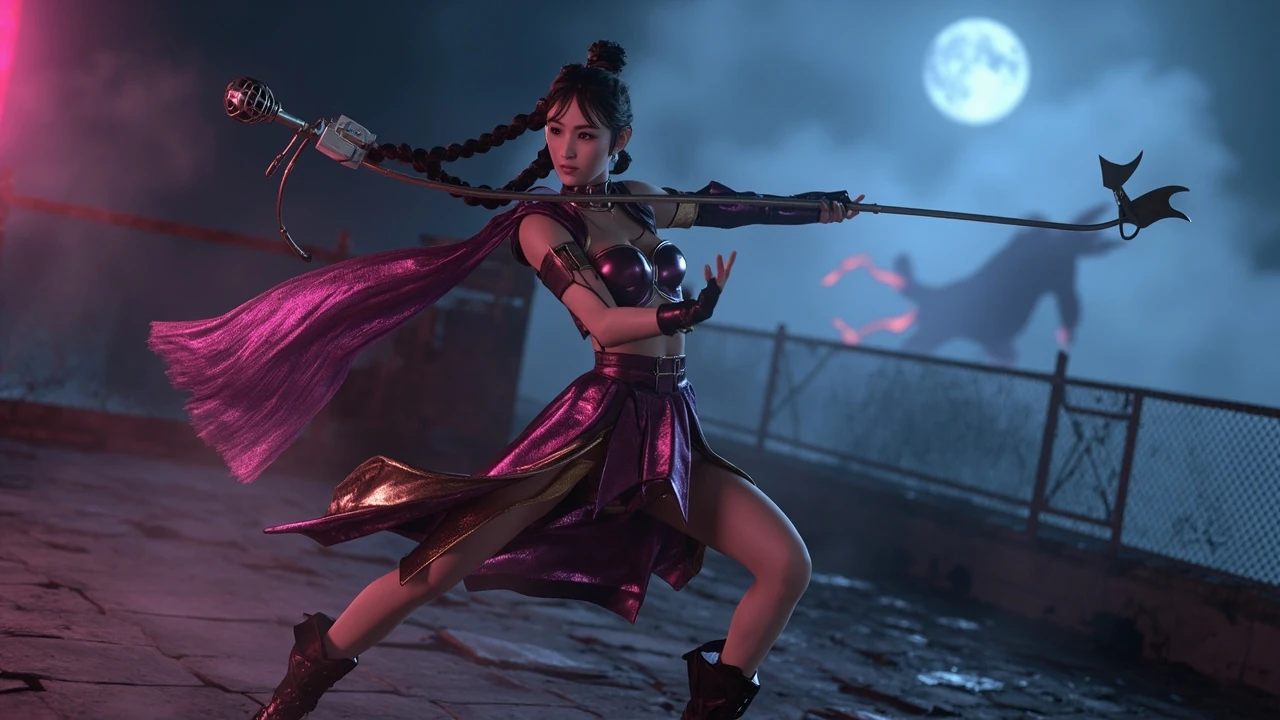
Rumi in KPop Demon Hunters: role, design, and combat
Rumi leads Huntrix, the three-person idol group at the center of KPop Demon Hunters. She sings the chorus, sets the tempo in combat, and carries the half-demon heritage that gives the group its emotional tension. For players learning the game and for developers studying how a small roster holds together, Rumi is the cleanest character to break down because her stage persona, weapon, and combat moves all push the same idea: a frontline anchor who fights the way she performs.
This piece looks at Rumi through a game development lens. It covers the intent behind her place in the trio, the combat mechanics that separate her from Mira and Zoey, the audio choices that link her singing to her fighting, and the production trade-offs a studio weighs when building a character whose identity has to survive both a music number and a boss arena.
Who Rumi is in the KPop Demon Hunters roster
Huntrix is a three-person idol group in KPop Demon Hunters, and Rumi is the lead vocalist and emotional center of that group. She is part-human and part-demon, a heritage that drives both the story and the mechanical tension of the game. She draws on demonic power for combat, but her relationships, her music, and her public identity are anchored in her human side. The game uses that duality as a hook, the way action titles often tie a protagonist’s strongest abilities to the part of their backstory the player is meant to wrestle with.
The trio pairs Rumi with Mira, who leans on ranged damage and agile dodges, and Zoey, whose role skews toward support and area control. Rumi sits between them as the bruiser-leader. She is the character the camera follows during key duets, the one whose health pool the team composition assumes, and the figure who introduces the player to each new system. That placement lets the design team teach mechanics through one character and then deepen those systems through the rest of the roster.
Design intent: a frontline anchor with stage presence
Rumi’s silhouette was built to read at three distances: from a wide arena shot, from a mid-range cinematic, and from a close-up music video frame. The character model uses a saturated magenta and deep gold palette, which stands out against the cool blues and grays of the supernatural environments. The cut of her outfit borrows from stage wear rather than armor: asymmetrical lines, layered fabrics, and a microphone motif that doubles as a weapon grip. That choice is deliberate, because her combat animations have to look credible both on a sound stage and in a fight.
From a production standpoint, this kind of dual identity is expensive. Every prop, cloth simulation, and idle pose has to survive scrutiny in two different camera contexts. Studios that attempt it usually build the character in two passes: first a clean silhouette that reads in motion, and then a layered pass that adds motion-capture-friendly accessories without breaking the silhouette. Rumi’s design follows that pattern, with simple base shapes that can be embellished or stripped back depending on the scene.
The practical upshot for the player is that Rumi is immediately legible as the protagonist. She is the largest, brightest, and most central figure on screen, which keeps the camera work clean even when the arena fills with enemies, projectiles, and particle effects.
Combat mechanics built around Rumi’s role
Rumi’s kit is structured to match her narrative role as a leader. She has higher base health than either of her teammates, access to a defensive counter, and a stance system that swaps between aggressive and defensive rhythms. The mechanics below are drawn from in-game descriptions and observed combat behavior, and they map to the responsibilities a lead character has in a co-op action game.
Primary weapon and reach
Rumi fights with a hybrid weapon that reads as a microphone and a bladed staff at the same time. In close combat, the staff handles like a mid-reach polearm, which gives her better spacing against groups of smaller demons than Mira’s short blades allow. The microphone end is used for charged heavy attacks, where the model opens and a small visual cue signals a wider hit arc. The dual-purpose design is more than cosmetic: it gives Rumi a longer optimal range and a clearer punish window than the other two Hunters, which fits her role as the player the team formation orbits.
Stance and rhythm system
Her core combat identity is the stance system, which switches between two combat states that mirror musical phrasing.
- Verse stance favors fast, light attacks and quick dodges. It is the right choice for crowds of minor enemies and for the buildup sections of a fight.
- Chorus stance favors slower, heavy attacks with extended hitboxes. It is the right choice for boss phases and for the moments when the audio mix shifts toward a fuller arrangement.
The stance swap is one of the cleanest examples of the game tying audio identity to mechanical identity. The player does not just hear a chorus drop; they also feel the combat weight change. That coupling is a deliberate design choice, and it is one of the better techniques on display in the roster for teaching players to listen to a fight as well as watch it.
Defensive counter and team utility
Rumi’s defensive counter is a parry that triggers a short window of stagger on the attacker. Mechanically, the counter rewards players who learn enemy tells, which is the same skill the team asks of players in a rhythm context. When Rumi successfully parries a heavy attack, the game grants a small team buff that increases damage for both Mira and Zoey for a few seconds. That buff is what makes Rumi a true leader in mechanical terms, not just in narrative terms. Her play is rewarded by the entire team rather than by her own damage meter, which is a sound architectural pattern for any co-op action game.
Demonic form and the design cost of an overpowered form
Rumi’s demonic heritage surfaces as a temporary powered-up state, gated by a meter that fills when she fights in tune with her teammates and drains when she fights alone or takes heavy damage. The form grants higher damage and a wider area of effect, but it also shifts her voice and color palette toward red, which is the visual cue the other characters use to decide whether to support her or hold back. The trade-off matters: an unlimited powered form would remove the team’s dependence on her, so the meter is tuned to make the form feel like a payoff rather than a default. The challenge for the design team is the same as for any character with a transformation mechanic: keep the form powerful enough to chase, but constrained enough that the rest of the roster still has a job.
Team role: how Rumi shapes the Huntrix trio
The Huntrix trio is built so that each member has a recognizable mechanical identity, and Rumi’s identity is the one the other two are tuned around. Mira is the ranged damage dealer whose role is to apply pressure from mid-range. Zoey is the support whose role is to manage enemy positioning and to extend the windows in which Rumi can safely stay on the frontline. Rumi is the bruiser whose role is to hold enemy attention and to convert openings into team-wide damage.
That division of labor matters in co-op balance, because each role has to be both viable on its own and clearly better in combination. A trio with a bruiser, a ranged dealer, and a support is a familiar architecture in action games, and the design uses that familiarity deliberately. Players who know how to read role composition feel at home, while players who are new to the genre get a clear, intuitive role for each character.
Audio design: connecting Rumi’s voice to her fight
Audio is the second pillar of Rumi’s identity, and the studio treats it as part of her mechanical design. Her combat sound design layers vocal fragments into heavy attacks, so a charged Chorus strike lands with a sung note rather than a generic impact. Her dodges are paired with breath sounds that are tuned to the on-screen tempo. Even her counter has a small audio signature that helps the player time follow-up attacks without looking at the meter.
The mixing approach is conservative in a useful way. Rumi’s vocals are pulled forward in the mix during her own attacks and pulled back during cutscenes, which keeps the player able to read both the fight and the story. For developers, the lesson is that an idol protagonist is not a marketing gimmick; it is a design constraint, and the audio team has to treat the voice as a usable instrument rather than as decoration.
Production trade-offs a studio weighs when building a lead like Rumi
Designing a lead character who is also a singer is a series of trade-offs. The list below summarizes the choices that tend to come up in production, with the reasoning that usually goes into each one.
- Animation budget: a lead needs more animation sets than a support, including idle, traversal, combat, song, and emotional variants. Studios usually either raise the lead’s animation count or accept a more limited set of cinematics.
- Cloth and hair simulation: Rumi’s layered outfit and long hair have to look right in two different camera contexts. Studios mitigate cost by reducing cloth simulation resolution on distant cameras and by baking the most expensive layers.
- Audio budget: each song the lead sings requires studio time, mix passes, and localization. A reasonable compromise is to keep two or three full vocal tracks and reuse instrumental stems for the rest.
- Localization: lip sync and vocal timing have to survive translation. Teams usually pre-render key story cinematics and leave the rest of the lines in audio-only form to control cost.
- Balance: a lead with the highest base stats and the strongest utility is easy to overshoot. A common approach is to lower her mobility relative to the rest of the roster, which is the trade-off Rumi’s kit actually makes.
None of these choices is unique to KPop Demon Hunters, but Rumi is a good example of a character whose design commits to a single identity and pays the production cost for that commitment.
Comparison: Rumi versus the other Huntrix members
The table below compares Rumi with Mira and Zoey across the attributes that matter most for a co-op action roster. The values are drawn from in-game descriptions and observed combat behavior, and they are intended to help players pick a main and to help developers see the role architecture at a glance.
| Attribute | Rumi | Mira | Zoey |
|---|---|---|---|
| Combat range | Mid (staff reach) | Close to mid (dual blades) | Long (ranged chains) |
| Base health | High | Medium | Low |
| Mobility | Medium | High | Medium |
| Primary role | Bruiser leader | Ranged damage | Support and control |
| Signature mechanic | Stance swap and parry buff | Combo chains with finishers | Area denial and team shields |
| Audio signature | Sung heavy attacks | Rapid instrument hits | Sustained backing vocals |
| Story position | Lead vocalist and protagonist | Main dancer and rival | Rapper and heart of the group |
The table shows the role split clearly. Rumi’s higher health and lower mobility reflect a classic bruiser trade-off, and her utility is the team buff that rewards her for staying on the frontline. Mira’s role leans on mobility and combo execution, while Zoey’s role leans on positioning and support. The trio covers the three roles a co-op action game needs without overlap, which is the cleanest way to design a roster of this size.
Stance reference at a glance
The table below summarizes the two stances Rumi cycles through in combat, the situations they fit best, and the audio cue that signals the swap. It is meant as a quick reference for players who already know the basics and want a compact side-by-side.
| Stance | Attack speed | Best against | Audio cue | Player trade-off |
|---|---|---|---|---|
| Verse | Fast, light | Crowds of minor enemies, buildup phases | Lead vocal line over sparse beat | Lower per-hit damage, higher dodge uptime |
| Chorus | Slow, heavy | Boss phases, single high-health targets | Full arrangement drop with backing vocals | Larger hit arc and stagger, lower mobility |
Players who swap stances in time with the music mix will get the cleanest damage windows, because the audio system is tuned to give the Chorus stance slightly longer invulnerability frames on the first hit after a swap. For broader production context around the cast, the KPop Demon Hunters Wikipedia entry covers the series premise and the Huntrix lineup. A separate interview with the lead voice actor, in which she describes originally auditioning for Celine, was published by the Times of India web series desk and is worth a read for anyone tracking how the casting landed.
How Rumi’s stance system changes the feel of a fight
The stance system is worth a closer look because it is the mechanical feature that most clearly connects Rumi’s identity to the rest of the game. The list below walks through a representative fight against a mid-boss demon, with the stance choices a player is likely to make and the reasoning behind each one.
- Open in Verse stance to build the stance meter while the boss is in a slow pattern. Use quick staff swings to apply pressure and to keep the meter climbing.
- Swap to Chorus stance when the boss begins its first major phase. The slower, heavier attacks match the boss’s new tempo and open the wider hit arc that the phase is tuned around.
- Use the parry counter against the boss’s telegraphed slam. The stagger gives the team a safe window to apply their own combos, and the team buff converts that window into a real damage spike.
- Switch back to Verse stance if the boss adds adds. The faster swings handle crowds better and let Rumi peel enemies off the team’s support character.
- Activate the demonic form when the meter is full and the team’s damage buff is active. The form is timed so that it lines up with the music’s climax, which is the moment the game asks the player to push for the kill.
The exact pattern varies by encounter, but the through-line is consistent. The stance system rewards listening as much as it rewards execution, and it gives the team a way to coordinate around Rumi’s tempo without forcing rigid callouts.
Player guidance: when to pick Rumi in a co-op run
Rumi is the right pick for players who want to set the pace of a fight rather than react to it. Her kit rewards the player who learns the boss pattern, calls the stance swaps, and is willing to hold the frontline while the rest of the team resets. She is the wrong pick for players who prefer to avoid the boss’s attention or to play from range, because her mobility and ranged options are the weakest part of her kit.
Players who already main bruisers in other co-op action games will find Rumi familiar. The interesting difference is the stance system, which is rare in the genre and which asks the player to think in musical phrases rather than in pure cooldown windows. If the player enjoys that mode of thinking, Rumi’s combat is one of the more rewarding bruiser kits in recent releases.
Developer notes: lessons from Rumi’s design
For developers, the useful lessons from Rumi’s design are less about specific numbers and more about how tightly the systems agree on a single identity. The list below summarizes the design patterns the character embodies.
- Lead with a single mechanical idea. Rumi’s combat reads as stance-swap first, parry second, and demon form third, in that order. That order is consistent across cutscenes, arenas, and boss design.
- Tie the character’s role to the team composition. Rumi’s parry buff exists because the team has a damage dealer and a support. Without that trio, her role would not work.
- Let the audio do mechanical work. Rumi’s sung heavy attacks are not decoration. They are the cue the player uses to time their strongest moves.
- Make the overpowered form temporary. A powerful transformation that is also gated is the simplest way to keep the rest of the roster relevant.
- Commit to a silhouette. Rumi reads as Rumi from across the arena, in a music video, and in a dialogue shot. The silhouette does most of the identity work, which is what makes her usable in all three contexts.
None of these patterns is unique to KPop Demon Hunters, but the game is a useful case study because it commits to all of them at once rather than picking one or two.
Voice acting and the casting question
One of the more interesting production questions around the lead role is casting. Arden Cho, who voices Rumi, has spoken publicly about originally auditioning for Celine rather than the protagonist, and the final casting ended up reshaping the emotional read of the part. Near-misses like that are common in voice casting, and the result is often a stronger performance than the planned one, because the actor arrives with a different emotional read on the material. For Rumi, the choice works because the performance leans into a leader’s steadiness rather than into the more reactive energy a Celine audition might have produced. For developers, the lesson is to allow casting flexibility in the audition stage, especially for a character whose role is the spine of the whole game.
What to watch in future updates and DLC
The most likely places for the studio to extend Rumi’s design are the demonic form, the stance system, and the team buff. The list below names the specific changes a future update or DLC would most plausibly introduce, along with the design reason each one would matter.
- New stance branches. The current system has two stances. A third stance, gated to a story milestone, would give the team a new coordination point and would give Rumi a new mechanical identity at the same time.
- Expanded demon form. The current form is a single powered state. A future update could split it into a short, intense form and a longer, weaker form, which would let the team tune the encounter to the player’s skill level.
- Team buff variants. The parry currently grants one team buff. A future update could add stance-specific buffs, which would make the stance choice matter even when no parry is available.
- Story-driven co-op chapters. The trio’s identity is built for three players. A future chapter that adds a fourth role would need to be careful not to dilute Rumi’s frontline role, and the cleanest way to handle that is to add a fourth as a specialist rather than as another generalist.
The through-line of these possible changes is that they deepen Rumi’s existing identity rather than replace it. That is the pattern the studio has followed so far, and it is the safest pattern for any lead character that already does the work of orienting the player.
Limitations and what this article does not claim
This article is a design and gameplay analysis, not a review. The mechanics and trade-offs described here are drawn from in-game descriptions and observed combat behavior, and they are intended to help readers understand how Rumi’s design works. They are not a substitute for hands-on play. The exact values for damage, health, and meter gain are tuned by the developers and change with balance patches, so any number in this article should be read as a qualitative description rather than as a tested value.
The casting section relies on a single published interview about the role, and the framing here is limited to what that source supports. Readers who want the production history should treat the interview as a starting point rather than as a final source.
Practical takeaways for two different readers
For players, the practical takeaway is that Rumi is a strong pick for a co-op team that wants a clear lead. Her kit rewards the player who learns the boss pattern, and her team buff makes her play visible in the rest of the team’s damage meter. For developers, the practical takeaway is that Rumi is a good case study in how to build a lead character whose identity is consistent across cutscene, music video, and combat. The patterns she embodies are not new, but the game’s commitment to all of them at once is rare and worth studying.
Frequently asked questions
Who is Rumi in KPop Demon Hunters?
Rumi is the lead vocalist and protagonist of the Huntrix trio. She is part-human and part-demon, and her character is built around the tension between her public persona as an idol and her private heritage as a hunter. In gameplay terms, she is the bruiser leader whose kit sets the pace of the team’s combat.
What role does Rumi play in the Huntrix trio?
Rumi is the frontline bruiser and team leader. She has the highest base health, the longest weapon reach, and a parry that grants a team-wide damage buff. Mira handles ranged damage and Zoey handles support and area control, which lets Rumi stay on the frontline as the team’s anchor.
What is Rumi’s signature mechanic?
Rumi’s signature mechanic is her stance system, which swaps between a fast Verse stance and a heavier Chorus stance. The swap mirrors musical phrasing, so the player’s combat tempo follows the audio mix. The system is the clearest example of the game tying a character’s identity to the rest of the team’s audio design.
How does Rumi’s demonic form work?
Her demonic form is a temporary powered-up state gated by a meter that fills when she fights in tune with her teammates and drains when she fights alone or takes heavy damage. The form grants higher damage and a wider area of effect, and it shifts her voice and color palette toward red. The form is tuned to feel like a payoff rather than a default, which is what keeps the rest of the roster relevant.
Is Rumi a good pick for new players?
Rumi is a reasonable pick for new players who want a clear role and a forgiving health pool, but her kit asks the player to learn the boss pattern and to coordinate with the team. Players who prefer ranged combat or who want to avoid the boss’s attention will find Mira or Zoey a better fit. The stance system has a short learning curve, but it is also one of the more rewarding systems in the game once it clicks.
How does Rumi compare to Mira and Zoey in combat?
Rumi has higher health and longer reach than either teammate, but lower mobility than Mira and lower ranged pressure than Zoey. Her utility is the team buff from her parry, which converts her defensive play into team-wide damage. Mira is the faster, more mobile damage dealer, and Zoey is the support who manages positioning and team shields. The three roles do not overlap, which is what makes the trio work as a co-op composition.
What audio design choices support Rumi’s combat?
Her combat sound design layers vocal fragments into heavy attacks, so a charged Chorus strike lands with a sung note. Her dodges are paired with breath sounds tuned to the on-screen tempo, and her counter has a small audio signature that helps the player time follow-up attacks. The approach treats her voice as a usable instrument rather than as decoration, which is one of the more interesting audio choices in the roster.
Did the casting for Rumi change during production?
Yes. According to a published interview, Arden Cho originally auditioned for Celine rather than Rumi, which is a useful reminder that final casting often diverges from the planned role. The final lead is voiced by a performer whose read on the character leans into a leader’s steadiness, and that read is one of the reasons the character’s emotional beats land cleanly.
What design lessons does Rumi offer for other co-op action games?
Three patterns stand out. First, a lead character should have a single mechanical idea that the rest of the design commits to. Second, a lead’s utility should reward the team rather than the lead’s own damage meter, which is what keeps the rest of the roster relevant. Third, a lead’s audio design should do mechanical work, which is what makes a character feel coherent across cutscene, music video, and combat.
What should players watch for in future updates to Rumi?
Players should watch for new stance branches, expanded demon form options, and team buff variants. The studio’s pattern so far has been to deepen Rumi’s existing identity rather than replace it, and the most likely updates will follow that pattern. Players who main Rumi should expect the kit to grow in depth without losing the role architecture that makes her readable in a co-op run.
Leave a Reply