
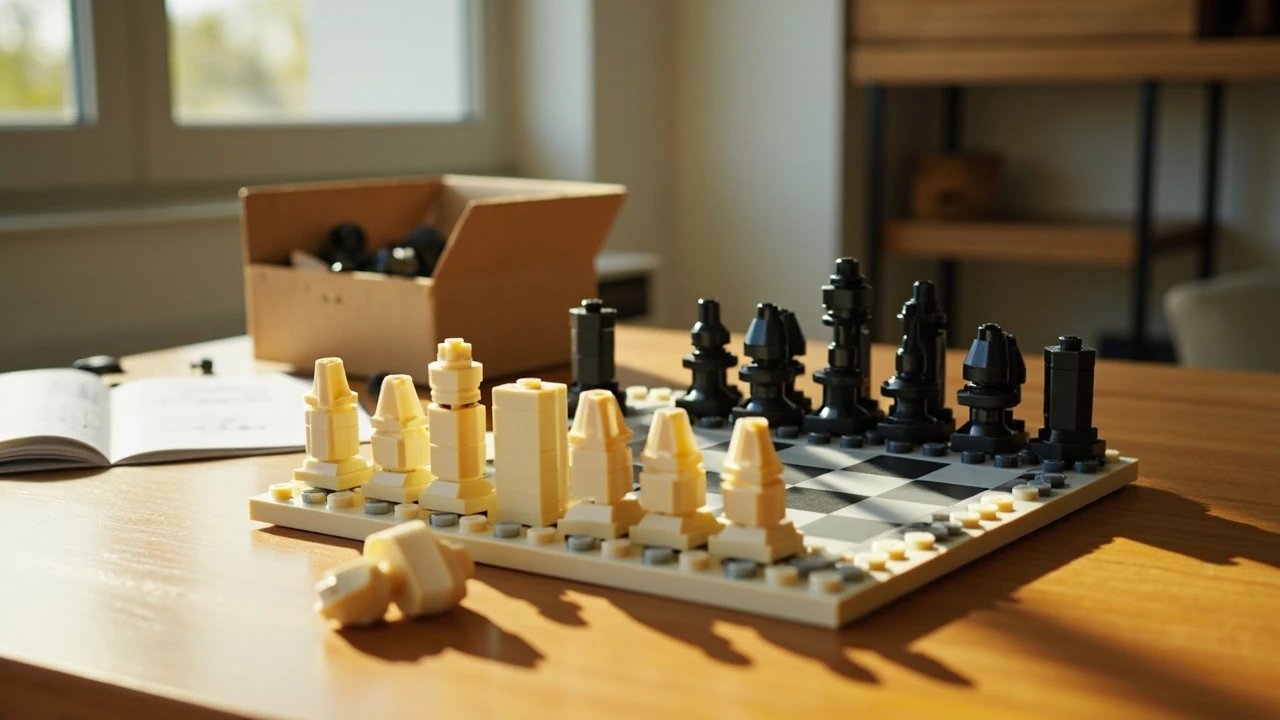
Lego chess set: where physical building meets two-player strategy
A Lego chess set is a hybrid object: half construction toy, half strategy game. The bricks let a builder shape the board, the pieces, and the rules’ physical form, while the underlying chess rules stay constant. For hobbyists, this creates a design problem that game developers also recognize: a fixed rule system has to be expressed through a build that is sturdy, readable, and replayable. Thinking about a Lego chess set with that lens turns it into a small, well-bounded design exercise that covers piece geometry, board ergonomics, and turn-based mechanics in a single physical artifact.
Building and playing a Lego chess set is also a useful way to think about how rules survive translation between media. The same ruleset that drives digital chess engines and mobile apps can be embodied in ABS plastic, and the choices a builder makes about scale, color, and stability are surprisingly close to the choices a UI designer makes about icons, hit targets, and contrast. This article walks through what a Lego chess set actually is, how the design has changed over time, what to consider before buying or building, how to plan a custom build, and what makes these sets durable as both toys and playable games.
What a Lego chess set actually contains
Although the bricks look familiar, a chess-themed Lego product is not just a generic set with a chess sticker applied to the lid. The pieces in a chess set have to be distinguishable at a glance from across a table, stable enough to survive a tap, and tall enough that one piece does not hide the piece behind it. Lego has solved these problems in different ways across official releases, fan designs, and third-party instructions, but the core components are remarkably consistent across all of them.
- A square board built from plates or tiles, usually 8×8 studs, with a contrasting center pattern that marks the dark and light squares.
- Thirty-two playing pieces, six types per side: pawn, rook, knight, bishop, queen, and king.
- A storage base, lid, or built-in tray that keeps pieces from scattering when the set is moved.
- Optional rulebook or quick-reference card, often replaced or supplemented by the player’s own chess knowledge.
- Occasional extras such as spare bricks, alternative decorations, or modular expansions that change the visual style without changing the rules.
The pieces are the part most often redesigned, because chess piece silhouettes are highly recognizable cultural shorthand. A Lego pawn cannot rely on subtle sculpting the way a metal Staunton pawn can. Builders compensate with proportion, color, and small architectural cues: a brick-built cross or finial for the king, a layered stack of plates for the queen, wedge slopes for the bishop’s mitre, and a slightly off-center head for the knight. The result is less about literal accuracy and more about a clear, readable gestalt that two players can identify at a glance, even when the board is partially in shadow.
It also helps to think about the supporting hardware. A chess set needs a surface that stays flat, a way to keep score (sometimes as simple as a captured-pieces pile), and ideally a way to reset quickly. Official releases usually address all three. Custom builds often solve the first and forget the third, which is why so many homemade sets end up with stray pawns living in jacket pockets.
How official Lego chess releases have evolved
Chess-themed Lego sets have appeared in several waves, and each wave reflects a different design priority. The earliest official treatments were small promotional items bundled with broader themes, and they tended to be more decorative than playable. Later releases, including larger collector-oriented sets, treated the board and pieces as the point of the build rather than an accessory. The line moved from simple builds toward more ambitious, display-oriented designs that still function as playable games, and that arc is documented on the Wikipedia entry for Lego Chess for readers who want the release-by-release history.
Two broad eras are worth distinguishing. In the first era, sets were small, often fewer than a few hundred pieces, and were sold as gifts or tie-ins. Playability was secondary. In the second era, which roughly coincides with the growth of adult-collector and 18+ lines, sets have grown to a few thousand pieces and treat the build itself as a long, satisfying construction project. The rules have not changed, but the time investment has. Builders now spend several hours on the build before the first move is played, and that shift changes how the set is marketed, stored, and priced.
Understanding which era a release belongs to matters because the design tradeoffs are different. A 200-piece set is cheap, fast, and forgiving, but the pieces tend to be blocky and the board is often a flat pattern on a baseplate. A 2,000+ piece set usually features a hinged or fold-out board, sculpted individual pieces, and a more elaborate storage solution. Neither is intrinsically better, but they are different products aimed at different audiences. A buyer who wants a project will enjoy the second era; a buyer who wants a quick gift will be happier with the first.
There is also a pricing pattern worth noting. As sets have grown in size, the per-brick cost has stayed roughly stable, but the total ticket has climbed. A $40 chess set and a $350 chess set both contain bricks, but they target different shelves in the retail catalog and different budgets at home. The hobby side of the Lego market has clearly influenced how chess sets are positioned, and that influence shows up in packaging, instruction density, and the inclusion of display stands.
Why the rules survive the medium change
Chess has been ported from ivory to wood to plastic to silicon to touchscreens without changing the ruleset, and Lego bricks are simply another substrate. The reason is that chess rules are about relationships between squares and pieces, not about the material the pieces are made of. A pawn still moves forward, captures diagonally, and promotes on the back rank whether it is a wooden token, a 3D-printed miniature, or a stack of 2×2 round plates.
That abstraction is a useful reminder for any game designer: the rules layer and the presentation layer can be developed almost independently. If the ruleset is robust, the presentation can be a digital UI, a tabletop diorama, or a Lego model, and the play experience remains recognizable. If the ruleset is fragile, no amount of material polish will save it. A Lego chess set works as a product because the underlying game is one of the most thoroughly playtested rule systems in history, with a written tradition that goes back centuries.
At the same time, the medium does introduce small frictions. A For additional context, digital chess app can enforce castling, en passant, and promotion prompts automatically. A physical Lego set cannot. Players have to remember the rules, agree on edge cases, and occasionally replace lost pieces. These frictions are not bugs; they are part of the social contract of playing chess in person, and they are part of why a physical set still feels meaningfully different from a screen. They also force players to slow down, which is not a bad thing for a game that rewards long-term thinking.
For hobbyists who like to tinker, those frictions are part of the fun. A custom piece for castling, a small marker for check, or a tray insert that sorts captured pieces is a satisfying side project, and each addition makes the physical experience a little more self-contained without changing the underlying game.
Design considerations before you buy or build
Whether the goal is a gift, a display piece, or a hands-on project, a few decisions should be made before committing. The same considerations apply to both official sets and custom MOCs (My Own Creations) built from instructions found online. The trick is to separate questions about playability from questions about display and storage, because the answers sometimes pull in opposite directions.
| Consideration | What to decide | Impact on the build |
|---|---|---|
| Primary use | Display on a shelf, regular play, or build experience | Display favors sculpted pieces and a hinged board; play favors simple, sturdy pieces and a flat board. |
| Piece scale | Mini-fig, micro, or larger custom | Larger pieces are easier to read mid-game; smaller pieces allow more detail and a more compact board. |
| Color contrast | High contrast (black vs. white) vs. themed colors (e.g. blue vs. red) | High contrast helps new players; themed colors can look better on a shelf and stay readable if saturation differs. |
| Storage | Built-in tray, separate box, or display case | A built-in tray reduces lost pieces but adds build complexity and weight. |
| Footprint | Compact travel size or full-size board | Travel sets sacrifice piece detail and play comfort; full-size boards need dedicated table space. |
| Skill of the builder | Beginner, intermediate, or advanced techniques | Beginner builds rely on stacked plates; advanced builds use SNOT (studs not on top) and technic reinforcement. |
| Budget in bricks and time | How many hours and how many parts to commit | Time tends to be the real constraint; a 1,500-piece build can take 8 to 12 hours even for an experienced builder. |
These decisions are not independent. A display piece with sculpted, intricate pieces usually has a larger footprint and is harder to pack away. A travel-friendly set is usually more abstract in its piece designs, with simpler silhouettes that survive being jostled in a bag. Knowing which axis matters most is the fastest way to narrow the choice, and it is also the best way to avoid the common disappointment of a set that looks great in marketing photos but does not fit the room or the routine it was bought for.
One practical test is to set up a mock board on a sheet of paper. Mark out the 8×8 grid at the size you are considering and try to play a few moves with coins as pieces. If the squares feel cramped or the board is too big for the only table where you actually play games, the chosen scale is wrong and the design brief needs to change before any bricks are bought.
Build planning for a custom Lego chess set
For builders who want to design their own set rather than buy an official release, the project is closer to a small game production than a casual model. It has a brief, a scope, a budget (in bricks and time), an art direction, and a usability target. Treating it that way is the best way to avoid the common failure mode of a set that looks great in photos but is awkward to play, or that plays well once and then falls apart in storage.
Define the player experience first
Before opening the brick bin, decide what a single game should feel like. Should it be a quick, casual match that fits in a coffee break, or a slower, ceremonial match that pairs with a long evening? The answer drives piece size, board size, and storage. Casual play rewards compact, light pieces that are easy to reset. A ceremonial match rewards heavier pieces, a more substantial board, and a storage solution that lets the set be uncovered slowly, almost like a ritual.
The room also matters. A set that lives on a coffee table in a family room has to survive children, pets, and the occasional drink. A set that lives in a study on a dedicated game table can afford to be more delicate. Builders who ignore the room end up rebuilding within a year.
Sketch the board and piece grid
Once the experience is defined, the next decision is the stud grid. The two most common choices are an 8×8 stud board built on 1×1 tiles or a board where each square is 2×2 studs to give more room for piece bases. The 2×2 square approach is easier for beginners because pieces sit on clearly defined squares, but it doubles the board footprint. The 1×1 approach is more compact and more difficult to keep aligned with traditional chess notation, but it produces a tighter, more elegant look on a small table.
There is also a hybrid approach: a 1×1 grid for the board, with each piece built on a 2×2 or larger base that overhangs the square slightly. This gives the visual cleanliness of a 1×1 board with the stability of a wider base, and it is the approach many experienced MOC builders prefer for that reason.
Build pieces that read at a distance
Each piece type needs a distinct silhouette that survives being squinted at from the opposite end of the board. The standard rules of thumb from MOC builders are:
- Use height as the primary differentiator. Kings should be the tallest piece on the board, then queens, then bishops and rooks, then knights and pawns.
- Avoid relying on color alone to distinguish pieces, because the contrast between the two sides already uses the strongest color difference available.
- Give each piece a flat or recessed base so it sits on a single square without wobbling.
- Use SNOT techniques (studs not on top) sparingly for accent details rather than for structural support, because sideways connections are weaker under repeated handling.
- Keep small details away from the top of the piece, where fingers will rub them off over time.
A useful trick is to build the king and queen first and place them at opposite ends of the board, then check whether they can be told apart at arm’s length. If the two most visually distinct pieces still look similar, the rest of the set will be worse, and the silhouettes need to be redesigned before more pieces are built.
Plan the storage around the playing surface
Most failed custom chess sets fail at storage, not at piece design. If pieces have nowhere to live between games, they migrate to couch cushions and never come back. The two most reliable solutions are a built-in tray under a hinged board and a separate foam- or brick-lined box. A hinged board is more impressive and keeps the set as a single object, but it adds weight and complexity to the build. A separate box is more forgiving and lets the set be split into a board and a parts bin, which can be helpful when the set is shared with younger builders.
Felt-lined trays from third-party suppliers are a popular compromise. The board is built without an integrated tray, the felt insert sits inside the lid, and the pieces drop into pre-cut slots when the game ends. The cost is small, the result feels finished, and replacement is straightforward if a slot wears out.
Comparing official, third-party, and custom Lego chess sets
Not every chess set with bricks on the board is the same kind of product. The differences in intent, build complexity, and playability are large enough that a side-by-side comparison helps avoid a bad match between buyer and product. The table below summarizes the main categories, with strengths, limitations, and the kind of buyer each one fits best.
| Type | Typical piece count | Strengths | Limitations | Best fit |
|---|---|---|---|---|
| Official Lego set | ~800 to ~3,000+ depending on release | High-quality instructions, reliable clutch, retail support, designed playability | Higher cost, limited customization, availability tied to production runs | Buyers who want a complete, supported product |
| Third-party instructions (e.g. bricks to bytes) | Varies widely, often 1,000 to 4,000 | More design variety, often free or low cost, active community feedback | Instructions quality varies, no warranty, may require specific parts | Experienced builders comfortable sourcing parts |
| Fully custom MOC | Whatever the builder chooses | Total control over theme, color, and piece design | High time cost, may require digital design tools, no external QA | Designers who want a unique display piece or a project build |
| Hybrid (official pieces, custom stickers or decals) | Matches the underlying official set | Lower cost than a from-scratch MOC, easy to revert | Limited visual change, stickers wear with handling | Builders who want a personalized look without a full redesign |
| Display-only diorama | 300 to 1,500 | High visual impact per brick, often sculptural | Not playable, fragile under handling, no storage for pieces | Collectors who want a chess-themed showpiece rather than a game |
These categories overlap. A builder might start with an official set, add custom flags or painted details, and end up with a hybrid that behaves like a MOC in daily use. The label matters less than the match between the set’s strengths and the owner’s expectations. A set that is bought for display but used for play will look worn within a year, while a set that is bought for play but treated as a display piece will frustrate anyone who actually wants to move the rook.
Replaying the same set across decades
For additional context, One reason a Lego chess set holds its value unusually well is that the rules do not go out of date. A chess set bought in 1990 is just as playable as one bought today, assuming the pieces survive. That durability is rare in consumer products and is worth designing around. A set built to be replayed for a decade or more looks different from one built for a single season.
Long-life sets share a few traits. They use stable color schemes that do not depend on a specific palette trend, as documented in long-running community resources such as the lego chess entry on bricks to bytes. They avoid rare or licensed parts that may be discontinued. They store cleanly, so pieces are not lost between games. And they have a board that stays flat, because a warped board slowly poisons the experience by making pieces lean and slide. None of these traits is glamorous, but together they decide whether a set is still playable in ten years.
From a sustainability angle, this also matters. A well-built Lego chess set can outlast several digital devices and a stack of board games. ABS plastic is tough, replacement parts are still produced for most bricks, and the rule system does not require updates. The up-front cost is higher than a cardboard chess set, but the per-year cost over a long lifetime can be lower, especially for a household that plays chess regularly and would otherwise be replacing worn boards every few years.
There is also a sentimental layer. A chess set that has survived a decade of moves, arguments, and house moves carries a small amount of history in its scratches. That history is not something a digital app can replicate, and it is one of the reasons a physical set is often kept long after the original builder has moved on.
Common failure modes and how to avoid them
Most problems with a Lego chess set fall into a small set of recurring patterns. Recognizing them early saves rebuilds later, and most of them show up within the first dozen play sessions rather than after years of use.
- Pieces too similar: if a bishop and a rook are hard to tell apart at speed, the set will frustrate players. Add a height or silhouette cue before color cues.
- Board warps: large flat boards built only from plates flex over time. Reinforce with a layer of tiles or a hidden frame of technic bricks underneath.
- Loose connections: pieces that rely on a single stud connection between body and base will shear off after a few games. Use at least a 2×2 footprint for the base, and avoid single-stud weak points.
- Lost pieces: a set without storage loses pieces quickly. Build or buy a tray, even a simple felt-lined box.
- Color confusion: very dark colors that look distinct indoors can read as identical in dim light. Test the contrast in the lighting where the set will actually be used.
- Top-heavy pieces: tall pieces with small bases tip over easily when the table is bumped. Widen the base or add a small counterweight brick near the bottom.
- Snapped SNOT joints: sideways connections that look clean on day one can crack after repeated handling. Reinforce critical sideways joints with a technic pin or a second connection.
Each of these is a design choice that surfaces after a few play sessions rather than at the build stage. Planning for them up front is much cheaper than rebuilding the set a year later, and it is also what separates a one-off project from a set that ends up living on a table for a decade.
Using a Lego chess set as a teaching and prototyping tool
Because the pieces are physical and the rules are familiar, a Lego chess set is a surprisingly good low-stakes test bed for design thinking. A team can use one to discuss game state, turn structure, and information design without needing custom software. Talking about how a player knows it is their turn, how they signal check, and how they remember whose move it is during a pause is essentially the same conversation a digital team has about UI state and notification design.
For younger players, the same set doubles as a tactile way to learn chess notation. Each piece is large enough to be picked up comfortably, and the board can be labeled with coordinates using small tiles or printed stickers. The point is not to teach chess faster than an app would, but to give learners a reason to slow down, talk through moves, and handle the pieces carefully. The handling itself is part of the learning, and it is also the part that is hardest to replicate on a touchscreen.
For developers, the lesson is that a working physical prototype exposes usability questions that digital prototypes often hide. A button on a screen is always perfectly stable and instantly responsive. A Lego piece has weight, can be misplaced, and can hide behind another piece. Designing around those frictions is good practice for any game, digital or not, that expects to be played in a living room rather than a lab, and it is also a useful exercise in accepting constraints rather than fighting them.
Educators have also picked up on this. Several classroom programs now use brick-built games as a way to teach turn-taking, rule-following, and spatial reasoning. A chess set is one of the simpler options because the rules are widely known, and a class can focus on the build and the social mechanics rather than on learning a new game from scratch.
Where Lego chess sits in the wider game-toy landscape
Chess is one of several long-lived games that have been ported into Lego form. Checkers, Go, and a number of abstract strategy games have all received similar treatments, both officially and from the fan community. What chess offers that simpler games do not is a deep, well-documented ruleset and a large community of players who already understand the meta. That makes a Lego chess set easier to recommend and easier to play with visitors who have never seen the set before, because the rules travel with the players rather than with the box.
It also makes the design more demanding. A chess set has six piece types per side, each with distinct movement rules, and the board state can be complex enough that visual readability matters. Designers working on these sets have to balance the fun of brick-building with the discipline of piece design, and that tension is what gives the best examples in this category their staying power. A chess set that looks like a chess set and plays like a chess set is genuinely hard to design well, and that difficulty is part of why good ones are remembered.
There is also a crossover with the broader collectible-toy market. Several third-party designers have used Lego-compatible bricks to make chess sets themed around popular franchises, and those sets occupy an awkward middle ground between display piece and playable game. They can be fun as a one-off gift, but the licensed parts are often the first to disappear when the set needs a repair, which is worth keeping in mind before paying a premium for them.
Practical next steps for a new builder or buyer
Once the high-level decisions are made, a short, concrete checklist helps move the project from idea to finished set. The order matters: decisions made later should not undo decisions made earlier, so it is worth working through the list top to bottom before starting a build or placing an order.
- Decide the primary use: display, regular play, or build experience.
- Set a piece-count budget and a footprint budget. These are the two hardest constraints to change later.
- Choose a color contrast scheme and test it under the room lighting where the set will live.
- Sketch six piece silhouettes, one per type, and check that they read at arm’s length.
- Build a single square and a single pawn as a quick prototype. If the pawn wobbles or the square looks wrong, fix it now, not after the rest of the pieces are done.
- Plan storage before scaling the build to the full board. Lost pieces are the most common reason a chess set is retired.
- Schedule a first full game with someone who has not seen the set before, and watch where they hesitate. Hesitation is a usability signal.
- Keep a small bag of spare parts with the set, including two or three of the most common brick types used in the build, for quick repairs.
Following that list turns a Lego chess set from a one-time build into a long-lived part of a game library. It also gives a buyer of an official set a way to evaluate the product: a good set will have answered most of these questions already, and a poor one will show its gaps the first time it is played. Either way, the list is short enough to run through in an afternoon and useful enough to keep around for the next chess-themed project, whether that project is another board, a checkers variant, or a full modular game table.
Frequently asked questions
How many pieces does a typical Lego chess set contain?
Official sets range from a few hundred pieces for smaller releases to a few thousand pieces for collector-oriented builds. Custom MOCs vary widely, but a comfortable mid-range project for a beginner designer lands around 1,000 to 2,000 pieces including the board. The piece count is less important than the piece-to-square ratio: a board with too few pieces per square will look sparse, while too many will make the build fragile and harder to repair when a single brick fails.
Can a Lego chess set be used for serious play or only casual games?
It can be used for serious play, provided the board is flat, the pieces are stable, and the squares are clearly defined. Tournament chess is played on regulated equipment, so a Lego set will not be legal for rated events, but club games, casual matches, and learning sessions are all realistic. The main constraint is piece stability: a piece that tips when bumped interrupts the flow of a serious game far more than an irregular pawn shape would, and that is the part most worth testing before committing to a build.
Are Lego chess sets a good gift for children?
They can be, with two caveats. The first is age-appropriateness: sets with many small pieces are not suitable for very young children, and the box’s recommended age range should be respected. The second is expectation-setting: a Lego chess set is a build project plus a game, not a fast-play toy. Children who enjoy construction will get a lot out of it, while children who want to start a game in five minutes may not. Pairing the set with a simple printed rulesheet is a low-cost way to bridge that gap and avoid the disappointment of an unopened box.
How do you replace a lost Lego chess piece?
For official sets, the Lego customer service replacement service handles individual missing parts in many regions, and replacement instructions are included in the original box. For custom builds, the fastest route is to identify the part by element number and order it through a parts supplier. Storing the original instructions with the set, even in digital form, makes any future replacement much easier because the parts list is already known and the design can be rebuilt exactly as intended.
What is the difference between a Lego chess set and a Lego chess decoration?
A set is a buildable product with instructions, packaged in a Lego box and supported as a retail SKU. A decoration is usually a smaller brick-built object meant to sit on a shelf and is not designed for regular play. Decoration pieces often look more detailed per brick but are fragile under handling. Chess specifically benefits from playable sets because the rules reward long, repeated use, so most buyers want something that can be played as well as displayed, and that combination is what the larger official sets aim to deliver.
Can a Lego chess set be customized after the official build?
Yes, and customization is one of the format’s strengths. Common changes include repainting or replacing individual pieces, swapping the color scheme, adding faction flags to denote sides, and rebuilding the storage tray for a different footprint. The only limit is stability: any modification that weakens the connection between a piece’s body and its base will shorten the set’s usable life. A simple rule is to test a modification for at least ten full games before committing to it as the new default, which is usually enough to expose any weak points.
How does a Lego chess set compare to a wooden chess set in daily use?
Wooden sets are usually heavier, feel more solid, and need less maintenance. Lego sets are lighter, more colorful, and easier to repair, and they double as a construction project. In practice, a Lego set is more forgiving in a household with children or pets, while a wooden set is preferred for tournament-style play. The two formats coexist comfortably, and many players own one of each for different occasions, with the Lego set getting the most use on weeknight games and the wooden set reserved for longer matches.
Is it possible to design a Lego chess set that also stores other games?
It is, and modular storage is a popular MOC approach. The idea is to build a board with a removable insert that holds chess pieces in one configuration and checkers or another abstract game in another. The trade-off is that the insert takes up space that could be used for a more generous chess storage tray, so the board tends to be larger. For a set that lives on a coffee table and gets used for several games, the modular approach works well. For a dedicated chess set, a single-purpose tray is usually the better choice, and it tends to be the option most custom builders end up preferring after a few iterations.
How long does a Lego chess set typically take to build?
Small official sets under 500 pieces can be assembled in an hour or two. Mid-range sets around 1,500 pieces usually take a full evening for an experienced builder and a long weekend for a beginner. Collector-oriented sets above 2,500 pieces often spread across several sessions, partly because the build itself is part of the appeal and partly because the pieces benefit from being sorted before assembly. The build time is worth treating as part of the cost, not just the bricks, especially for a set that is being given as a gift.
Can a Lego chess set be packed for travel without damage?
Yes, with a padded box and a piece tray. The board is usually the most fragile part because flat surfaces flex, so it benefits from a rigid base under it during transport. Pieces should be sorted into small bags or compartments so they do not grind against each other and wear down the printed details. A travel case built specifically for the set is the most reliable solution, and several third-party sellers offer foam inserts sized for popular Lego chess sets, which removes most of the guesswork from packing.
Leave a Reply