
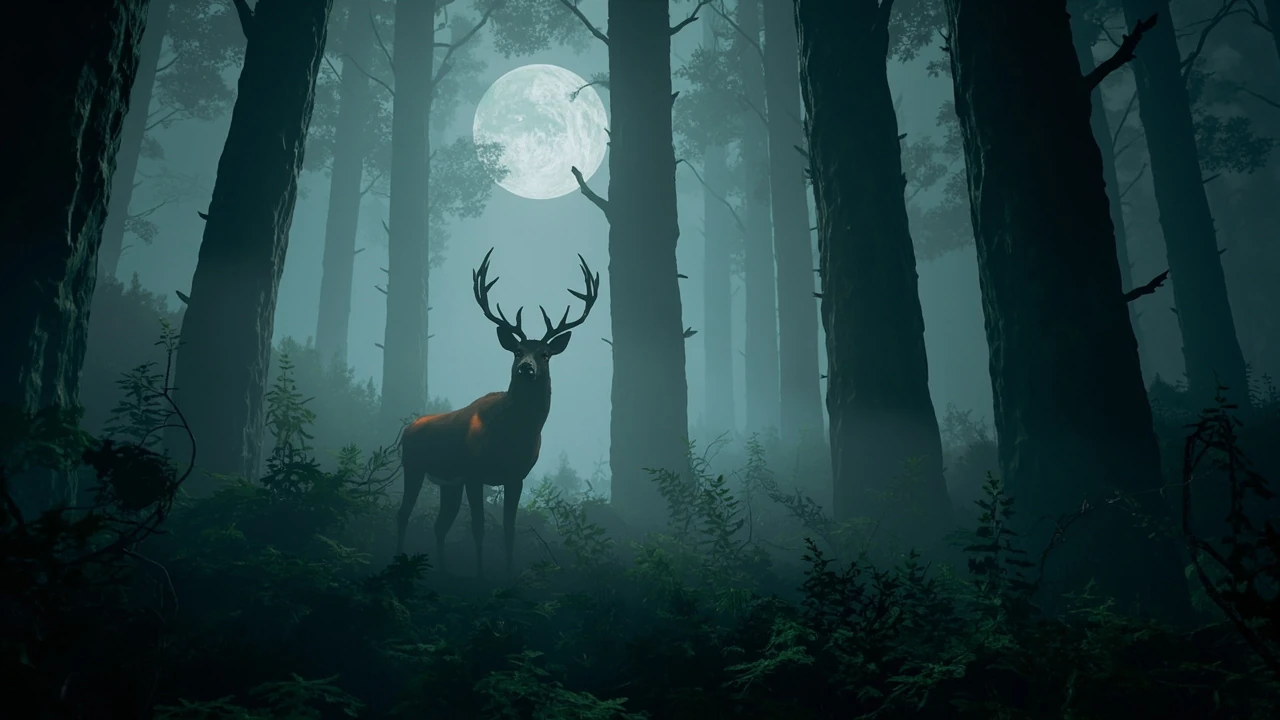
99 nights in the forest deer: what the mechanic actually does
The deer in 99 Nights in the Forest is one of the most discussed passive creatures in the game, partly because its behavior is easy to misread on a first playthrough. On the surface, the deer looks like ordinary ambient wildlife: a four-legged NPC that wanders the forest, grazes on grass, and bolts when the player approaches too quickly. In practice, the deer carries a layered set of behaviors that touch spawn rules, day and night cycles, encounter triggers, and reward logic, so designers and players both need to separate what the animal is, what it does, and what it gives when it is finally caught or killed.
For a developer, the deer is a useful case study because it sits at the intersection of three classic survival systems: passive fauna AI, encounter-driven progression, and resource gating. For a player, it is one of the better early-game sources of food and crafting material, and it is one of the few creatures whose behavior meaningfully changes between day and night. The rest of this article walks through the design, the observable behavior, the practical ways to interact with the deer, and the scripting patterns that recreate similar mechanics in a Roblox-style survival project.
How the deer fits into the 99 nights loop
99 Nights in the Forest structures progression around a fixed-length survival run. The player spawns with limited tools, has to gather food and materials, manage a fire, and survive a growing list of threats across 99 in-game nights. Each night typically escalates the danger, and many of the more memorable events are tied to specific creatures, items, or locations that the player is expected to learn over repeated runs.
Within that loop, the deer plays a small but well-defined role. It is not a boss, it is not a story character, and it is not required to finish the run. It is a renewable resource node that also acts as a soft tutorial for stealth and tracking. The deer gives the player a low-risk way to practice closing distance, observing line of sight, and dealing with an animal that runs away. Once that pattern is learned, the same habits transfer directly to more dangerous fauna later in the game.
From a design perspective, the deer therefore has three jobs at once:
- Provide a stable early-game source of raw meat and a small amount of leather or bone that other systems can consume.
- Teach the player how fauna movement, alertness, and sound radius work without punishing failure too harshly.
- Anchor a set of small, repeatable encounters such as grazing herd sightings and startled fleeing animations that make the forest feel alive between more dramatic events.
Each of those jobs shapes a different part of the deer’s behavior, which is why a flat description of the animal misses the most useful details.
Deer behavior across the day and night cycle
Daytime and nighttime deer behavior in 99 Nights in the Forest follow very different scripts, and conflating them is the most common reason new players think the deer is bugged. During the day, deer tend to stay in the open, often near clearings, rivers, and the edges of the forest. They graze in small herds, slowly drift between feeding points, and only react when the player gets within a relatively short radius. A careful approach at a walking pace usually lets the player close to melee range or line up a thrown tool without spooking the entire herd.
At night the rules change. The deer is more skittish, its detection radius appears wider, and it tends to move toward denser tree cover. This is consistent with how the rest of the game becomes more dangerous after dark: lower visibility, more hostile fauna, and more events that draw the player away from the campfire. The deer is not an exception, but the change in its behavior is subtle enough that some players only notice it after several runs.
| Time of day | Where deer tend to appear | Detection behavior | Best response from the player |
|---|---|---|---|
| Early day | Forest clearings, near rivers, open grass patches | Short detection radius, grazes in place | Walk slowly, approach from downwind, line up a thrown tool |
| Late day | Edges of the tree line, mixed cover and grass | Medium detection radius, moves between feeding points | Use trees for cover, close the last few meters in a crouch if available |
| Early night | Dense tree cover, shadowed paths | Wider detection radius, flees at greater distance | Aim for body shots from range, avoid chasing into dark areas |
| Late night | Deep forest, near event-heavy zones | Very skittish, often already in motion | Skip the deer unless low on food, focus on camp defense |
These four bands are not strict timers built into the deer; they are observable patterns that come from how the deer’s alertness, spawn rules, and the player’s visibility interact. A player who is also carrying a lit torch, for example, will spook deer earlier at every band because the torch increases the player’s effective detection profile.
Tracking, line of sight, and the spook radius
The deer’s most important behavior parameter is what most survival systems call the spook radius. In 99 Nights in the Forest it appears to combine line of sight, distance, and movement speed. If the player is within a certain cone of vision and moving quickly, the deer will almost always bolt. If the player is outside that cone, the same distance is usually safe. A stationary player at moderate range is rarely a problem at all.
This produces three practical lessons that apply to almost every encounter in the game:
- Speed matters more than distance. A slow walk from twenty meters is often less risky than a sprint from ten meters.
- Breaking line of sight resets the alert state. Walking behind a tree, then peeking out, is more reliable than continuing a direct approach.
- Sound travels through vegetation. Running through tall grass or brush raises the deer’s alertness even when the player is technically hidden.
For developers, this is a classic example of a layered detection system: distance, line of sight, speed, and a separate noise channel that the player cannot see directly. Each of those can be tuned independently, which is why the deer feels different at night even when the underlying numbers have not been changed for the player to see.
Combat, harvest, and what the deer actually drops
Once the deer is downed, the game treats it as a short-lived harvest node. The body stays in the world long enough to loot, and the player can extract raw meat, a small amount of bone, and occasionally a better drop such as a heart, a pelt, or a recipe-relevant material depending on the current patch and the player’s progression state. None of these drops are guaranteed, which is intentional: renewable food sources need to feel reliable, but the rarer drops are what give deer hunting a small upside over simply foraging.
Players who only need calories can usually ignore the rare drops and treat the deer as a steady source of raw meat. Players who are pushing deeper into the game and working on specific recipes will want to track which deer kills produced the rare drops, because that information is one of the few signals the game gives about which spawn points are currently active and which are quiet.
| Drop | Typical use | How often it appears | Notes for players |
|---|---|---|---|
| Raw meat | Cooked at the campfire for food | Always, on a successful kill | Most reliable calorie source among passive fauna |
| Bone | Crafting and repair components | Common, but not guaranteed per kill | Useful when other bone sources are depleted |
| Pelt | Crafting and certain upgrades | Uncommon, varies by region | More frequent in cold or deep-forest zones |
| Heart | Special recipes and progression checks | Rare, tied to specific encounters | Often appears with named or larger deer variants |
| Bonus crafting material | Recipe-specific inputs | Patch-dependent | Check current patch notes for the active list |
Developers reading this can treat the table as a model of how a renewable resource node is balanced. Common drops are constant, useful but not overpowered, and scale with the player’s food pressure. Rare drops are scarce, tied to conditions the player can influence, and create a small but real reason to revisit the same spawn points across runs.
Spawn rules, herd exhaustion, and population control
The deer does not appear in a single random location each night. Spawning is tied to biomes, distance from camp, and a soft population cap per region. In practice, the game keeps a counter of how many deer are alive in each chunk of the forest. When that counter is high, new spawns are delayed. When the counter drops below a threshold, the region starts to refill.
That is what produces the herd exhaustion pattern. A group of deer that is spooked by a player will scatter, leave the local area, and remain absent from that region for a while. The player cannot grind the same patch for an hour. Pushing into a new region usually reveals fresh deer, even on the same night, because the counter in that region has not been touched. This is also why overhunting one clearing eventually forces the player to learn two or three backup spawn points.
For developers, this is a useful pattern to lift directly. A simple region-based counter, combined with a slow refill timer, gives the same behavior with very little code. The counter can be tracked per biome, per named region, or per grid cell, depending on how much variation the project wants to support.
Designing a similar deer in a Roblox survival project
For developers building a Roblox-style survival game, the 99 nights in the forest deer is a compact reference for several common patterns. The first pattern is a passive fauna AI that is a finite state machine rather than a single script. A reasonable starting structure is:
- An
Idlestate where the deer grazes in place, plays a looping animation, and periodically selects a new target point inside a wandering radius. - An
Alertstate where the deer stops moving, raises its head, and starts a short timer. If the player leaves the detection area before the timer ends, the deer returns toIdle. Otherwise it transitions toFlee. - A
Fleestate where the deer chooses a direction roughly away from the player, runs for a fixed distance or time, then transitions back toIdleat a safe point. - A
Deadstate where the deer model is replaced with a ragdoll or a static harvest node, and the loot table runs once.
The second pattern is environmental awareness. The detection check should not be a single sphere around the deer. It is usually more believable to use a forward-facing cone for vision, a small sphere for close-range awareness, and a separate noise channel that is triggered by the player’s movement and tool use. That is exactly the structure that produces the difference between daytime and nighttime behavior in the reference game: at night, the cone is effectively wider and the noise threshold is lower, even if the underlying state machine is unchanged.
The third pattern is loot variability. A simple implementation is a weighted table that runs once when the deer enters the Dead state, with a guaranteed row for raw meat and a small set of optional rows for the rarer drops. Conditional rows can be added so that hearts only drop during specific nights, in specific regions, or after the player has met a progression flag. That keeps the deer useful in every run while still giving the encounter some long-term texture.
Common bugs and how to debug them
Three deer-related problems show up again and again in survival projects, and the same debugging checklist tends to surface them quickly.
The first problem is the deer that refuses to flee. Usually this means the Alert state is reachable but the transition to Flee is gated by a flag that is set elsewhere in the script, such as a global “player stealth” value. The fix is to log the values of that flag and the alert timer at the moment of transition, and confirm that the player’s stealth value is what the state machine thinks it is.
The second problem is the deer that runs into walls, off cliffs, or into the water. This is almost always a pathfinding issue rather than an AI issue. The deer’s chosen flee direction is usually correct, but the path service cannot find a route to it. The fix is to clamp the flee target to a known walkable region, add a small upward offset, and fall back to a generic “run forward” if the path remains empty after a short retry loop.
The third problem is the deer that drops nothing. This is usually a loot table bug rather than a kill confirmation bug. The kill is registering, the Dead state is being entered, but the loot script is running on the client while the server is the one that should own the drop. The fix is to move the loot roll to the server, broadcast the result to the client only for visual feedback, and make sure the guaranteed row is always present so the player is never left with a body and no reward.
How the deer compares to other fauna in the same game
Compared to the other passive and aggressive creatures in 99 Nights in the Forest, the deer sits at the easier end of the spectrum. For additional context, it does not attack, it does not summon help, and it does not have a special one-shot mechanic. That makes it a useful baseline for thinking about how the game scales difficulty across its fauna roster.
| Creature | Role | Detection style | Player counterplay | Why the deer is a useful comparison |
|---|---|---|---|---|
| Deer | Passive resource node | Short visual cone plus noise | Slow approach, break line of sight, use thrown tools | Reference for stealth and tracking fundamentals |
| Small aggressive fauna | Early pressure | Moderate visual range, no stealth check | Create distance, use terrain as a barrier | Shows how detection rules diverge from the deer |
| Mid-tier hostile fauna | Mid-run threat | Wider detection, sound-sensitive | Crouching, fire, bait items | Demonstrates how the same noise channel is reused |
| Boss-tier creatures | Run-defining encounter | Custom rules per encounter | Specific counters, preparation, team play | Highlights how far a tuned detection system can scale |
The table is also a useful planning artifact for a developer. If a new creature needs to feel different from the deer, the developer only needs to change one or two of the four columns. Widening the visual cone and removing the noise channel, for example, gives a “relentless tracker” feel without rewriting the state machine. Tightening the cone and adding a memory timer gives an “ambush predator” feel instead.
Player tips that also explain the design
Most player advice for the deer is also design advice in disguise, which is one of the reasons the creature is a popular topic in community guides. A few patterns are worth calling out explicitly.
- Hunting near a river or clearing is more reliable than hunting deep in the forest, because the deer’s spawn distribution and the player’s visibility both work in the player’s favor.
- Killing deer at the edge of the player’s line of sight preserves the herd. Panicking the whole herd means the player will not find deer in that patch of forest for a while, because the spawn rules treat a spooked herd as temporarily exhausted.
- Carrying a lit torch at night is a tradeoff. The torch helps the player see, but it also widens the deer’s effective detection of the player. The right answer depends on whether the player is hunting or trying to reach a destination without being seen by more dangerous creatures.
- Throwing a tool at a fleeing deer is usually more efficient than chasing it. The chase takes the player away from safe terrain and burns stamina or tool durability for an unreliable payoff.
Each of these tips encodes a design decision. The spawn distribution rewards edge hunting. The herd exhaustion rule punishes panic. The torch detection is a deliberate tradeoff rather than a bug. The chase cost is a soft deterrent that pushes the player toward ranged tools. None of those decisions are accidental, and they are the same kinds of decisions that show up in nearly every well-tuned survival game.
Animation, sound, and the small details that sell the creature
The mechanics are only half of what makes the deer feel right. The other half is the layer of small, repeated feedback that the player picks up without noticing. The grazing animation cycles through head-down and head-up poses, which lines up with the deer’s Alert state. The fleeing animation is a longer, faster gait that the player learns to read as “you have been spotted, and there is no point chasing.” The death animation is short and quiet, which keeps the encounter from feeling like a boss fight.
Sound matters as much as animation. The deer has a soft idle call, a louder alert call, and a short panic call when it flees. None of those are loud enough to draw other creatures on their own, but they do tell the player what just happened, which is the entire point. A deer that grazes in silence and bolts in silence would still work mechanically, but it would feel flat.
For developers, the practical lesson is to budget time for these small details early. A single audio cue per state and a single animation transition per state is usually enough. Trying to fully lip-sync the deer to the player’s actions is wasted work, but a flat model that snaps from idle to flee is also wasted work. The middle ground is what the reference game lands on.
Performance and network considerations for fauna AI
Deer are deceptively expensive in a large survival world because there are many of them and they run on the server. A few engineering decisions tend to matter more than the AI itself.
First, server-authoritative AI is the right default. The player can spoof position, but the server cannot trust the client’s view of where a deer is. That means the state machine, the detection check, the pathfinding, and the loot roll should all run on the server, with the client only receiving replicated transform updates and animation events.
Second, replication should be event-driven for transitions and throttled for movement. There is no need to replicate every frame of a deer’s idle motion. A periodic position update and a single animation event for state changes is usually enough for the client to render the deer believably.
Third, fauna populations should be capped per region. A flat “spawn ten deer in the whole map” approach produces empty patches and crowded patches. A regional cap that resets slowly is closer to what the reference game does, and it is what creates the herd exhaustion pattern that the player tips above depend on.
Finally, the detection check itself is a common performance sink. A naive implementation checks every player against every deer every tick. A more efficient approach uses spatial partitioning so that only the deer in the same region as an active player are evaluated, and only the players near a given deer are considered as potential threats. That is enough to scale passive fauna into the hundreds without overloading the server.
Adjusting the deer for difficulty modes
Once the core deer system is in place, it is tempting to leave it alone across difficulty modes. In practice, the reference game uses a small set of toggles that change how the deer feels without rewriting the state machine.
On easier modes, the deer’s detection cone is narrower, the noise threshold is higher, and the spawn cap per region is larger. The result is a friendlier forest where the player has more chances to learn the system. On harder modes, the cone widens, the noise threshold drops, and the spawn cap shrinks. The result is a forest where the deer disappears faster and punishes sloppy play.
For developers, the lesson is to expose these values as data, not constants. A single configuration table that the rest of the script reads is enough. That makes it possible to tune the deer without searching the codebase for hard-coded numbers, and it makes it possible to ship seasonal or event variants that change the same numbers for a limited window.
Common design mistakes when porting the deer to a new project
A few mistakes come up often when the deer pattern is copied into a fresh project, and they are worth naming directly.
The first mistake is using a single sphere for detection. It is faster to write, but the result feels artificial. A sphere-detecting deer either ignores the player behind a tree or reacts at the same distance from every angle, and both of those break the illusion.
The second mistake is forgetting the noise channel. Without it, the deer only reacts to direct line of sight, and the player can crouch in tall grass and walk right up to it. That feels cheap rather than clever, and it removes the tradeoff the cone and noise system is supposed to create.
The third mistake is over-tuning the loot table. A deer that drops three rare items in a row feels broken, and a deer that drops nothing useful for ten kills in a row feels punishing. The reference game’s approach, with one guaranteed row and a small set of optional rows, is a safer default. If the game needs more rare drops, the better fix is usually to add a second creature with a different table, not to inflate the deer’s drops.
Where the deer fits in a longer roadmap
The deer is a useful first creature to ship, but it is not the last. A reasonable roadmap goes from passive resource nodes like the deer, to small aggressive fauna, to mid-tier threats, to boss encounters. Each step in that ladder reuses parts of the same scaffolding, which is what keeps the codebase small as the roster grows.
Passive creatures get the detection and state machine in their simplest form. Small aggressive fauna add a basic attack state and a short aggro timer. Mid-tier threats add memory, telegraphed attacks, and conditional loot. Boss encounters add scripted phases, environmental interactions, and team-oriented counterplay. None of those layers are required for the deer itself, but the deer is the layer that makes the later ones feel coherent, because the player has already learned the underlying detection and noise rules.
Frequently asked questions
Is the deer in 99 Nights in the Forest a hostile creature?
No. The deer is a passive creature and will not attack the player. Its behavior is built around fleeing, not fighting. If the deer is causing damage or blocking movement, the cause is almost always a different creature or an environmental hazard, not the deer itself.
What is the best time of day to hunt the deer in 99 Nights in the Forest?
Late day, around the edges of clearings and rivers, is the most reliable window. The deer’s detection radius is still manageable, visibility is good, and the player can usually close to melee range or line up a thrown tool without spooking the entire herd.
Do deer respawn after being killed?
Yes, but not instantly. The herd in a given patch enters a temporary exhaustion state, during which new deer will not spawn in that area. After a short in-game period, the patch refreshes. Players who push deeper into the forest should expect to find fresh deer in new regions sooner than in regions they have already over-hunted.
Why does the deer run away so much more at night?
At night the deer’s effective detection radius increases and its noise tolerance decreases. In practice that means the player is detected from farther away and any loud action, including sprinting, is more likely to trigger the alert and flee states. This is a deliberate design choice that matches the rest of the game becoming more dangerous after dark.
What is the deer good for in terms of progression?
The deer is most useful as a steady source of raw meat and a small amount of bone in the early and mid game. The rarer drops, such as hearts and pelts, feed into specific recipes and progression checks. The deer is not required to finish a run, but a steady supply of meat keeps the player fed through longer nights, which is what makes the rare drops more accessible later on.
Can the deer be lured or trapped?
Within the reference game, deer can be influenced indirectly by where the player stands and which tools are thrown, but they do not respond to bait items in the way some other survival fauna do. For developers, the deer is therefore a clean example of a creature that is best handled through positioning and timing rather than through dedicated bait systems.
How can a developer recreate the 99 nights in the forest deer behavior in Roblox?
A state machine with Idle, Alert, Flee, and Dead states, combined with a forward-facing detection cone, a small close-range awareness sphere, and a separate noise channel, reproduces the core behavior. A weighted loot table with a guaranteed raw meat row and several optional rows handles the drops. Spatial partitioning and a regional spawn cap keep the system performant at scale. These patterns are general enough to apply to most Roblox survival projects, not just direct clones of the reference game.
Does the deer scale with the night counter in 99 Nights in the Forest?
The deer itself does not become significantly tougher across the run, but the world around it does. Later nights bring more aggressive fauna into the same regions where deer spawn, which means hunting the deer becomes more dangerous even though the deer’s own stats have not changed. Players should treat late-game deer hunting as a side activity that costs time, not a free source of food.
What is the difference between a deer encounter and a herd encounter?
Single deer are usually the result of a small spawn tick in a low-density region or a leftover from a previous herd. Herds are larger groups that spawn together in higher-density regions. Herds reward patience, because panicking one deer usually panics the rest. Single deer reward aggression, because a quick, clean kill is less likely to draw attention from nearby creatures.
What is the most common reason the deer feels bugged?
In most cases, the deer is behaving as designed and the player is reading a different signal. The three most common misreadings are confusing the noise channel with the visual cone, expecting instant respawns after a herd panic, and assuming that the deer’s daytime and nighttime parameters are the same. Adjusting for those three points usually fixes the perception that the creature is broken.
Leave a Reply