
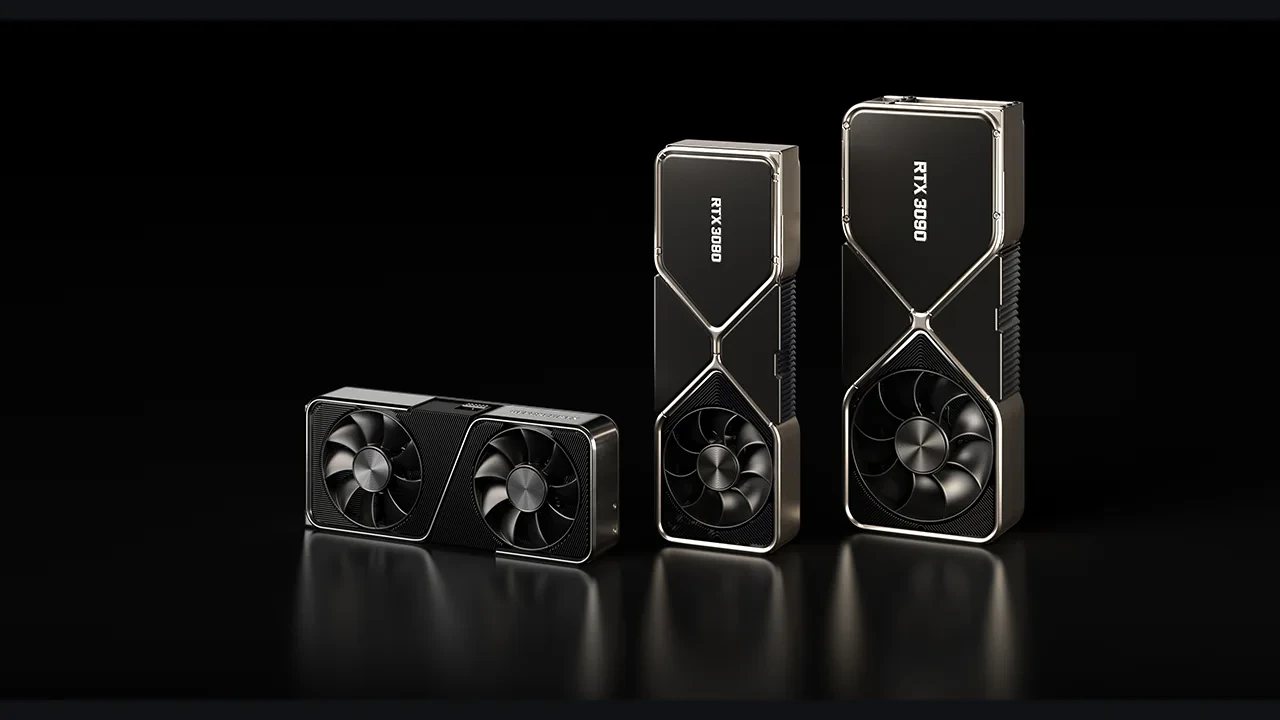
No official DLSS 5 launch support has been announced for the GeForce RTX 3090 Ti. Studios using this card should keep DLSS 4.5 Super Resolution and Ray Reconstruction as the shipping path until NVIDIA publishes a different support boundary. That is also the route most current PC projects build against.
That is a production decision, not just a label. It affects renderer integration, test hardware, graphics-menu behavior, and every feature promise made to players.
GeForce RTX 3090 Ti DLSS 5 compatibility: the verified answer today
The published record does not place the GeForce RTX 3090 Ti in the official DLSS 5 launch set, and later support remains unknown. Despite its continued use in player panels, contractor machines, and older studio workstations, the card has no confirmed DLSS 5 route today.
For an active project, use DLSS 4.5 Super Resolution and Ray Reconstruction on this hardware. Any DLSS 5 plan belongs on a watch list, not in a release commitment.
The RTX 30 series overview on Wikipedia helps place the card within Ampere. Previous DLSS features have reached family members in waves, but that history does not let a developer infer support from a press demo, leaked driver, or adjacent SKU. The only safe planning statement is the dated, published one.
Why a powerful card can still miss a new DLSS path
DLSS 5 is the next generation of NVIDIA’s deep-learning supersampling stack and uses the same broad class of color, motion-vector, and depth data supplied to earlier versions. NVIDIA’s technical and marketing material points to better reconstruction and temporal stability, which naturally raises questions from owners of older RTX flagships.
The 3090 Ti still looks formidable in 2026. It has 24 GB of GDDR6X, a wide memory bus, and the ray-tracing and Tensor hardware used by earlier DLSS versions. Raw capability puts it in the conversation, but it does not place the model inside NVIDIA’s support contract.
Projects should therefore treat DLSS 5 as a later option. Keep DLSS 4.5 available on the 3090 Ti and expose any new path only on hardware NVIDIA names, preferably behind a runtime capability check.
The confirmed DLSS 4.5 route
The RTX 3090 Ti fully supports DLSS 4.5 Super Resolution and Ray Reconstruction. Both consume the familiar temporal inputs used across the DLSS family. The practical engineering task is to keep that path clean while leaving room for a separately gated future integration.
Inputs to verify before judging image quality
A typical renderer submits a color buffer, motion vectors, depth, and exposure or pre-exposure data, then receives an output buffer ready for presentation. Audit these inputs before blaming the upscaler:
- Supply color at the selected internal resolution, with tone mapping applied before submission when the SDK expects pre-tonemapped input.
- Provide per-pixel screen-space motion vectors using the same camera jitter as temporal anti-aliasing.
- Pass depth in the engine’s visibility format and handle reversed-Z consistently.
- Include exposure or pre-exposure so history remains stable as brightness changes.
- Expose the output rect and sharpness setting beside the player’s resolution scale.
Bad motion vectors or pre-exposure can create subtle instability. A 3090 Ti often reveals those faults clearly even when a faster card masks their cost with throughput.
Treat the vendor list as a hard boundary
NVIDIA’s compatibility list defines what the launch integration has been tested to support. A GPU omitted from it is outside that contract. The 3090 Ti is supported by DLSS 4.5 but not officially by DLSS 5, so the developer-facing and player-facing message should say the same thing.
Terms such as “future-proof” or “ready for the next generation” create expectations the studio cannot control. State what works now and avoid implying an NVIDIA announcement that hasn’t happened.
Internal feature flags need the same discipline. Do not default a DLSS 5 branch to on because the card seems powerful enough. Mirror the official list and keep any override in an obvious non-shipping build configuration.
What the 3090 Ti still offers in 2026
The card’s 24 GB of GDDR6X gives a game room for high-resolution shadow maps, ambient-occlusion targets, and reflection probes at the same time. Its Tensor and RT cores already run DLSS 4.5, and the memory bandwidth can feed a 4K internal target at sensible quality settings in many projects.
On this hardware, profile bandwidth, residency, and ray-tracing cost. A moderate ray-tracing budget is comfortable, but path-traced scenes with many bounces exceed the throughput of newer generations sooner. Lowering internal resolution through DLSS 4.5 eases the bandwidth pressure and remains a well-understood production route.
Ship 4.5 now and gate 5 separately
A 2026 project can ship DLSS 4.5 with a stable SDK, known hardware set, and familiar QA process. DLSS 5 remains a future path for the RTX 3090 Ti. Treat it as an optional branch available only after NVIDIA confirms the card.
| Aspect | DLSS 4.5 on GeForce RTX 3090 Ti | DLSS 5 on GeForce RTX 3090 Ti |
|---|---|---|
| Official launch support | Yes, supported target | No official launch support announced |
| SDK availability | Generally available through NVIDIA developer channels | Not part of the verified launch boundary for this card |
| Recommended default for a 2026 PC release | Yes, as a primary or secondary upscaling option | No, should not be the default on this hardware |
| Memory and bandwidth demands | Consistent with DLSS 4.5 inputs and outputs on the card | Future workloads, not validated on this card |
| Player-facing messaging risk | Low, matches the published support list | High, would imply support that is not officially confirmed |
| Internal QA gate | Standard CI path on the 3090 Ti test rig | Internal feature flag, off by default on the 3090 Ti |
This is a release-planning comparison, not a performance benchmark. The left column is available now; the right records what remains outside the verified boundary.
A practical integration sequence
Remove assumptions from the build one at a time.
1. Record the supported path
Put DLSS 4.5 and the relevant SDK version in the rendering design before opening integration tickets. A short note linked to the supported-GPU list gives engineering, QA, and production one baseline.
2. Validate DLSS 4.5 on the card
Bring up a reference scene on a 3090 Ti and inspect the renderer inputs rather than relying on a clean final image.
- Capture one frame at the selected internal resolution with every DLSS input visible in RenderDoc.
- Display motion vectors as color and check foreground, background, and camera movement.
- Visualize depth to confirm reversed-Z and consistent near and far planes.
- Move the camera through a known scene and watch UI, hands, and decals for ghosting.
- Repeat at another exposure to verify pre-exposure handling.
3. Isolate the upscaler interface
Once 4.5 is stable, keep inputs, outputs, sharpness, and scale behind a small abstraction. That is enough to add an officially supported alternative later without rebuilding the renderer.
4. Make the menu match detection
An RTX 3090 Ti should receive a working DLSS 4.5 control and no unsupported DLSS 5 entry. If newer GPUs get the latter, hide or disable it on hardware outside NVIDIA’s list. Patch notes and marketing need the same rule.
Use plain language with players
The 3090 Ti still performs like a current-generation card in many games, yet it is absent from the DLSS 5 list. Support notes can say that it runs DLSS 4.5 and that the studio is waiting for official information before exposing DLSS 5.
Owners are reasonable to ask, but a vague “we’re looking into it” suggests knowledge the studio may not have. A dated status is more credible.
How unsupported paths leak into release builds
The usual cause is an overly broad automatic feature flag. It sees a capable generation rather than an approved SKU and selects code QA never validated. Ghosting, smearing, or a crash may be the first player-visible symptom.
- An auto-detection rule checks a GPU generation instead of the exact support list.
- A preprocessor flag compiles the new route into an older-hardware build, leaving a menu option with no valid runtime path.
- Options data defaults the feature on and overrides the hardware gate.
- The QA matrix omits a 3090 Ti, so players find the regression first.
These are ordinary integration mistakes. Exact detection, an explicit default, and representative hardware prevent them.
Audit an official support-list update
When NVIDIA publishes a new list, check these points:
- The desktop section names the GeForce RTX 3090 Ti without qualifiers.
- The feature uses the familiar Super Resolution-style path or documents another input contract.
- The SDK notes include a minimum driver, and the project’s driver floor can move if required.
- The 3090 Ti receives a new QA pass on the correct feature or release branch.
- The graphics menu gains only options whose defaults match the list.
If the card remains absent, retain DLSS 4.5. If it appears, the change becomes a normal feature rollout with a date and test plan.
Scale the same default across a wider GPU matrix
Small teams may choose one default upscaler and one optional alternative, while larger teams can expose several. In either design, the RTX 3090 Ti belongs on the established DLSS 4.5 path until official material moves it.
| Player profile | Hardware expectation | Upscaler default | Engineering risk |
|---|---|---|---|
| High-end desktop on RTX 30 series, including the 3090 Ti | DLSS 4.5 class upscaling at 4K or 1440p | DLSS 4.5 | Low, well-trodden path on the 3090 Ti |
| Mid-range desktop on RTX 30 series, such as the 3060 Ti or 3070 | DLSS 4.5 class upscaling at 1080p or 1440p | DLSS 4.5 | Low, smaller internal resolution reduces the pressure on the GPU |
| High-end desktop on RTX 40 series | DLSS 4.5 and possibly DLSS 5, if officially supported | DLSS 4.5, with DLSS 5 exposed if on the official list | Low to medium, depends on the support list and the QA matrix |
| High-end desktop on RTX 50 series | DLSS 5 as a likely default, with DLSS 4.5 as a fallback | DLSS 5 if officially supported, otherwise DLSS 4.5 | Low for the supported path, medium if a future path is exposed too early |
| Laptop and mobile SKUs across all series | Conservative defaults, power-aware scaling | DLSS 4.5 in most cases, with the resolution scale tuned for the chassis | Medium, depends on the thermal and power budget of the specific chassis |
The table describes how a support list controls defaults. It is not a purchasing recommendation.
Use a written process when support changes
- Read the complete NVIDIA list, including footnotes and minimum drivers.
- Date the updated boundary in the design document and link its source.
- Change menu visibility and defaults to match.
- Add the affected rigs and paths to QA.
- Revise internal support notes and public patch notes together.
- Schedule another review for the next release in case the boundary moves again.
A support change touches rendering, UI, QA, customer support, and release notes. A short procedure keeps those copies synchronized.
Keep the names precise
DLSS 4.5 means the current production package containing Super Resolution and Ray Reconstruction. DLSS 5 means the next-generation package discussed in the launch material. GeForce RTX 3090 Ti means the exact desktop SKU, not the RTX 3090 or a mobile model. Those distinctions prevent an adjacent card or feature from being substituted by mistake.
The 2026 shipping decision
A broad RTX release should use DLSS 4.5 as the 3090 Ti default and reserve DLSS 5 for officially supported hardware behind a strict gate. Players on this card deserve a tuned 4.5 implementation, not a nonfunctional promise.
This status can change. The RTX 30 series Wikipedia overview shows where the card sits, and NVIDIA’s DLSS 5 launch and compatibility page is where a later support update should appear. Until then, 4.5 is the route a studio can actually ship.
Frequently asked questions
Does the GeForce RTX 3090 Ti support DLSS 5?
No official launch support has been announced. Its verified path is DLSS 4.5 Super Resolution and Ray Reconstruction.
Is the RTX 3090 Ti still a good card for PC games in 2026?
Yes. It has 24 GB of GDDR6X, a wide bus, and Tensor and RT hardware that already runs DLSS 4.5. It remains useful for mid-to-high-end profiling with a measured internal resolution, although it has no confirmed DLSS 5 route.
Will DLSS 5 be added to the RTX 3090 Ti in a future driver?
Current verified sources cannot answer that. Later support remains unknown, so studios should not promise it.
What is the difference between DLSS 4.5 and DLSS 5?
DLSS 4.5 is the shipping package with Super Resolution and Ray Reconstruction. DLSS 5 is the next-generation package discussed in the launch material. Their support lists differ, and the 3090 Ti belongs only to the former today.
Can a game expose DLSS 5 on a 3090 Ti through a mod or a config file?
A mod cannot extend NVIDIA’s official list. Such a route is an unsupported third-party experiment with no studio or vendor validation.
What should a developer test on a 3090 Ti rig for a DLSS 4.5 path?
Capture a frame at the chosen internal resolution, inspect motion vectors and reversed-Z depth, watch UI and decals for ghosting, and repeat at another exposure. Those checks verify the data supplied to the upscaler.
How should a player options menu handle a 3090 Ti?
Expose DLSS 4.5 as supported. Hide or disable DLSS 5 unless NVIDIA adds the card, and make the default follow the same list.
What happens if NVIDIA adds the RTX 3090 Ti to the DLSS 5 support list later?
Update the design, menu, QA matrix, and support notes, then schedule another review. The game still needs an SDK and build change; a list update alone does not modify the client.
Is DLSS 4.5 the same as DLSS 4?
No. DLSS 4.5 is a specific current package of Super Resolution and Ray Reconstruction. DLSS 4 is an earlier package in the family, and its similar name does not erase different support boundaries.
Where can I check the current DLSS 5 support list?
Check NVIDIA’s DLSS 5 launch and compatibility page. Use the RTX 30 series Wikipedia overview only for family context.
Leave a Reply